Jump to content

BHR eyedropper


GlenV

Recommended Posts

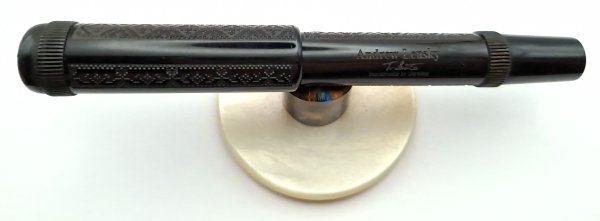
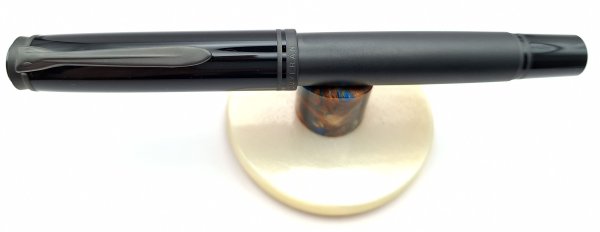
This is a simple eyedropper just 5 parts as advertised by Waterman a long time ago. This is my first attempt at a pen of this type, with vintage nib and feed, and turned pen from Japanese ebonite. I made it about the size of a Waterman 16 but with a 2/4 size feed. The  Waterman feed should be ( and had been with use)  well behaved and a Warranted nib.  I am looking forward to making some other eyedropper pens too. 

large.IMG_5208.jpeg.0714b0d77e7ac654fede
large.IMG_5206.jpeg.b9c5edfa31e39e2f2c4f
large.IMG_5209.jpeg.414b164e3d4e8423fc9b
size compared with a 40’s Commando 

Regards, Glen

Link to comment
Share on other sites

  • 3 weeks later...
  • Replies 14
  • Created
  • Last Reply

Top Posters In This Topic

  • GlenV

    9

  • VacNut

    2

  • cellopen

    1

  • Sinjin

    1

I find myself returning to this post. I think the simplicity and clean shape of your pen is quite attractive. I have a weakness for ebonite slip-cap pens; everything that is needed, and nothing superfluous. There is beauty in that. Thank you for sharing.

Link to comment
Share on other sites

Thank you I am partial to pens from that era, this one has been inked all week and working great may be beginner’s luck 😏.  There is also some cool brown pattern in the cap mostly as was a bit close to the unfinished surface of the ebonite rod, I am quite pleased with how it worked out.

large.IMG_5319.jpeg.86802c3c864f55cf3246

Regards, Glen

Link to comment
Share on other sites

You do great work.

May I ask, which machine tools did you use? Do you need anything else beyond a good hobbyist lathe?
thx

Link to comment
Share on other sites

You are a bit too kind I’m definitely learning but lots of experience with wood lathe. I recently bought a bench top (larger than a jeweler’s lathe) metal lathe and the possibilities are exciting. Mine is a Wen brand, and ebonite from Vermont Freehand they have been great.

Regards, Glen

Link to comment
Share on other sites

  • 4 weeks later...

Another homemade pen, this taper cap, in the early pen style again, getting a bit better but still having to redo some parts, to get the finished pen I’m happy with. I’m also working on a reliable homemade feed design, this one is based on the Lincoln pen by AA Waterman, Frazier and Geyer (sp?) after warming up and blotting it works really well without any flow problems, about as well a Waterman feed. I used a nice nib it’s a Ingersoll dollar pen nib, I like this nib alot, 

large.IMG_5386.jpeg.82f8f742b5b86758f46f
large.IMG_5387.jpeg.4f603bc43acd2964ed57
large.IMG_5384.jpeg.02e924063f85428bd00a

Regards, Glen

Link to comment
Share on other sites

  • 3 weeks later...

I found your posts after thinking I wanted to try learning how to turn ebonite pens because I love my old waterman eyedroppers so much. I love what you’re doing and I want to learn how to do it myself. Do you have any suggestions for where I should start learning/reading?

Link to comment
Share on other sites

The main issue for me is getting a lathe, after that you can play with ebonite and other materials without that much expense.  You tube has cool penmaking and metal lathe videos, but you have to jump in sometime and start trying to learn by doing, it's all fun though. I didn't really plan on getting a metal lathe, but am having fun learning, lots more to learn (thread making on the lathe)

Regards, Glen

Link to comment
Share on other sites

I went with the WEN 7x16 inch bench top metal lathe, it's easy to get here at Home Depot not sure as available where you are though?

Regards, Glen

Link to comment
Share on other sites

  • 4 months later...

Such beautiful work. There is so much elegance in these understated designs. That taper cap is fantastic. Bravo. 

Link to comment
Share on other sites

Thank you! That is my favorite pen, especially since I made a home-made feed, and it actually works well!  Still like most eyedroppers it will drip when first filled and warmed up in the hand so if that is anticipated it then works great for as long as it has ink. The nib is a particularly nice vintage Charles Ingersoll. Hopefully if I make another similar feed it will work as well. I've been itching to try to make an overfeed pen like the Wirt style but not sure it will be such a reliable user if I do. I have a couple dip pen nibs coming to see if one will work for that project.

Regards, Glen

Link to comment
Share on other sites

  • 2 weeks later...

Another project to make a Wirt type fountain pen, early type overfeed eyedropper. This one took some practice (and some wasted BHR rod) and a couple tries to get an early dip pen nib that would work. I went with the 2 part Wirt syle feed that I have seen in an early secretary Wirt pen that I think is original.

I think I understand why this style works so well and really was (some may disagree of course but in my mind appears this way) the first practical fountain pen. 
It seems like the ink would drip out the opening below the nib but it doesn’t. The overfeed delivers ink over the nib slit constantly, and appears to arrive there along each side of the overfeed mainly and drawn under the feed. I was considering that the diameter of the section opening is critical to have surface tension enough to prevent dripping and allows free balance of air entering and even with warming after filling doesn’t drip which is better than most droppers.

 I think these were reliable pens, worked better than the Swan over under feed style and the early Waterman feed ( which was later improved). 
My try is still a learning process and the flaw of this pen is not having enough room for ink in the barrel and would likely not last a full day’s work but I think I made the section threaded part too thin and limits how much the barrel can be drilled although I could have drilled it deeper, still am happy with it and really happy it works.

I see in the photos some more polishing needed on the cap yet..  and vent holes but nearly done here.  I have found that condensation occurs in these eyedroppers I've made without vent holes and likely would fade the rubber so have included vent holes to avoid this.
large.IMG_5802.jpeg.726d999c15e92bd9a280
large.IMG_5803.jpeg.604075cfbd429aac1340
large.IMG_5804.jpeg.60f6a1fae9fbfd54a932
large.IMG_5805.jpeg.b486b49a10400f243784

Regards, Glen

Link to comment
Share on other sites

Truly master craftsmanship! You sir, got a keen eye on what makes 'vintage' aesthetic so desirable! 

large.my_eyes_hurt.png.7ca4a507e8a0978dddd3e9ad65266f13.png

Link to comment
Share on other sites

Thank you!  It’s really quite alot of fun both to try to make and to try to understand what made an early pen like this work. 

Regards, Glen

Link to comment
Share on other sites

Create an account or sign in to comment

You need to be a member in order to leave a comment

Create an account

Sign up for a new account in our community. It's easy!

Register a new account

Sign in

Already have an account? Sign in here.

Sign In Now


×
×
  • Create New...