Jump to content

Schneider vs. Waldmann Ball-pens


Recommended Posts

https://www.youtube.com/watch?v=2eEvFjTzBEo


German TV had a short program in German about the production of ballpens - cheap vs expensive, mass-produced vs hand-made, Schneider vs Waldmann.

Youtube offers automatic transcripts, quite good but still quite wrong sometimes. I corrected the transcripts followed by machine-translation (deepl.com). I didn't fully correct the output.


The Waldmann pen mentioned in this program are the Grandeur and the Xetra Vienna while the Schneider pens are the Slider Rave and the Reco.


0:00

And now it's about a product that can cost four euros but also 2800 euros. It is about the ballpoint pen. And now you probably ask yourself "what can the expensive one do better than the cheap one"? As you can see, they are of course produced in a completely different way. That is a difference, let's see where the other differences are and where the similarities are.


You can get ballpoint pens for free, for a few euros in any store, or for a few hundred euros for more luxurious models.

How do these big price differences come about? Materials, workmanship, writing feel, what distinguishes the mass-produced from the luxury model ? We have looked into two extreme areas.


1:00 Schneider

We start in the Black Forest at one of the largest German producers, about 400 employees manufacture 250 million ballpoint pens here every year.

Mass producer and family business, current boss Christian Schneider, grandson of the founder: "We just have blue ink in our blood and from that point of view the ballpoint pen is at the top of our list."

The manufacturer has been producing the refills with the blue ink for more than 70 years and made the ballpoint pen suitable for mass use as a plastic version in Germany in the 1950s.

"My favorite pen is the Slider Rave, it has a great feel, grips quickly, grips softly, brings a rich color application and that's why I just love it."

The boss's favorite pen consists of 13 individual parts. In contrast to the manufactory, which specializes in individual components, the large manufacturer produces almost every component itself, including the heart of the pen, the tip. For this, the Swabians use sturdy wire and the eponymous sphere. The larger the ball, the easier it is to write.

"But the tip production for a ballpoint pen is the most complicated department or step to go through. If the ball is not in order, or even the ball clearance doesn't match the paste exactly, then the ballpoint pen itself can't be used properly either."


The complicated mechanism was invented by László József Bíró. How the Hungarian came up with the idea for the revolutionary writing device is the subject of many stories and rumors.

As a newspaper editor, he is said to have been so annoyed by the blotting with the fountain pen that he wanted to develop a smudge-proof writing instrument. Some say children playing marbles gave him the solution. When the marble rolls through a puddle, it leaves a wet trail. Others say he was inspired by printing rollers, an ink like printing ink that dries as soon as it is on the paper. However he came up with the idea, the fact is that he first patented a ballpoint pen, the GoPen, in 1938. The pen still bears the name of the inventor - Biro - in many languages.

Only 10 years after the first patent, the first ballpoint pen machines, a la Biro, are produced here. Employee Joerg oversees the complicated production step for the heart of the pen - the tip. "In the first production stage, the ring stock is placed on the machine, straightened, fed into the machine and sheared off as a blank. There we have certain dimensions and tolerances that we have to adhere to so that no problems arise for further processing."

For further processing, Joerg personally guides the individual wire pieces to the next machine. The machine shapes the raw pieces of wire into their final form, milling a small indentation in each one for the ballpoint pen. Precision is important here, because if the ball is too tight, the ink cannot come out; if the ball is too loose, too much ink gets onto the sheet and the pen smears.

In order for the ink to reach the ball at all, the writer needs a refill. This is the ink cartridge of the pen. The hardest work is done by a machine. With a little human assistance, the refill machine fills 40 million metal parts a year with the viscous paste, in this case blue.

"I favor the blue color, of course, which is also what we process most here in Germany. But there are other countries where other colors are then just decisive, for example France, where it is rather black."

Refills are available in plastic and metal. Metal is more expensive, but lasts longer. Thanks to a thinner wall, there is more space for ink. Before the machine (refill?) actually writes, it has to go through a centrifuge. This is operated by employee Christian.

"During the centrifuging process, the plate rotates at 1200 revolutions for 1.5 minutes and this ensures that the air can escape from the tip and thus the writing system is ready for writing.

The centrifuge spins the ink forward quickly. Afterwards, the employee personally tests whether this has worked.


5:45 Waldmann

The manufacture of luxury writing instruments about 100 km away does not have its own refill production and machine cycle. Here, 15 employees handcraft expensive writing instruments from expensive materials. The factory is quieter and smaller than the big manufacturer, but it is also a family business. Stefan Schnirch, the third generation of the family to run the business, says: "I'm always asked what I write with. And then, of course, I have my favorite - currently our Grandeur ballpoint pen."

Between the boss's favorite and custom-made pens for celebrities and noble houses, this luxury pen is also part of the assortment. It consists of more individual parts than the everyday pen. However, small parts such as the tip or barrel come from local suppliers. This is because production focuses on special components. Compared to mass producers, the raw material here is already precious: 3 meters of pure silver.


An employee first has to transform this into a more manageable ballpoint pen size. This could theoretically be done by machine, but the manufactory deliberately opts for manual labor.

"If we were to do this operation with a machine, the risk is too high that the individual barrels would be dented, scratched. That means they become unusable for us for further processing and our Uwe, he does it so routinely and so quickly and that we drive better here, drive more economically than with the machine."

Uwe has been shaping the raw material into fine ballpoint pens here for eleven years.

"Yes, I think the best thing about my job is that I can virtually accompany the entire manufacturing process from start to finish. Yes, it also gives me a bit of professional pride that you can only do it by hand nowadays, because you can always do it by machine.

The jewelry machine mechanic devotes himself to each individual component with the utmost care. After all, the writing machine will cost almost 400 euros in the end. The next step, the annealing process, is hot. Uwe heats the tubes to 600 degrees in order to be able to form the silver without any problems. Under these conditions, pens for up to 2,700 euros are made here.

"If you don't do that, then it can be, it wrinkles and becomes wavy."

Wrinkles should not be created in the next step, but the final shape of the pen. This changes only minimally in our eyes, but the noble manufactory attaches great importance to every little detail.

Uwe has machine support here but nothing runs automatically during the deformation.

"So, this is actually my favorite activity. Yes, that requires routine, skill and experience."


9:00 Schneider

The production of the pen case looks a little different for the mass product. Instead of silver, there's plastic here, and instead of Uwe, this arsenal of machines.

"We are here now in our plastic molding shop, where we produce all the semi-finished parts, all the plastic parts for our ballpoint pens. Below us is the material supply where the raw plastic is available. It is then virtually pressed into our injection mold by the screw."

What makes it special is that part of the mold is rubberized, so you don't slip off when writing. Any more tricks for a good pen mold ?

"What makes a good pen mold is that it is comfortable to hold. In mass production, you can only produce a mass that is the same. Otherwise you have an individual product which is expensive. Speaking of mass, this machine alone produces 34 pens per minute.


10:00 Waldmann.

In the manufactory, on the other hand, the housing of the noble ball-pen is far from finished. The large-scale manufacturer dyes the raw material before processing; in the manufactory, the color only comes into play after forming.

"The experience we had to make with our high-quality writing instruments is that this combination black-silver or pure silver is best for us. The end consumer, he associates with this valuable and also timeless pieces this color combination."

In addition to the right color, the most important thing is to get plenty of paint on each side. The thicker the layer of paint, the longer it lasts, an important quality feature for a product that is supposed to last a lifetime.


11:00 Schneider

To make sure that these pens also have mass life, the major manufacturer puts its products to the test. What quality characteristics should the everyday pen meet ?

"In general, it should write immediately, because that is the first impression, as in a job interview the first criterion. The second criterion is soft writing, that you don't experience any strain in your arm, that's our focus, that's created."

Incidentally, a refill of this model only passes the quality test if it can write at least 4,000 meters at a stretch, enough for an entire book, for example, the manuscript of Harry Potter Volume 1, which J.K. Rowling wrote by hand. But we don't know if it was done with everyday or luxury writers.


11:55 Waldmann

in the manufactory, quality assurance takes on an even greater significance. After each of the 28 steps in the process, Stefan Schnirch and his employees check the components.

"The special thing about our writing instruments, whether they are ballpoint pens or fountain pens, is that we carefully inspect every component, every single part that is used, throughout the entire production process.

The boss uses a magnifying glass to find even the smallest dents or scratches.

"So we very often have defects in here that we sort out. But I'm grateful for that because it shows me that we're human beings here, that we work as human beings."

The aim of this meticulous control is to guarantee quality and to sort out faulty parts as early as possible. It would also be unfortunate if the next step were in vain.

Martin is responsible for the trademark of the noble ball-pen, the hand engraving, quite a lot of responsibility.

Nothing can go wrong. You can conceal a flaw here especially with the pattern, so you don't see more."

After 50 years in the trade, the engraver is not easily ruffled. Martin conjures the intricate pattern entirely without a template.

"If you engrave something with a machine, yes everything will be the same. If you make 1,000 pieces, they're all one hundred percent the same, but here, every piece is what's unique."

Martin makes each pattern unique, but similar enough for the product line and, surprisingly, in just 20 minutes.


13:55 Schneider

Of course, the large-scale manufacturer does not produce individual pieces, but rather masses of plastic goods. We ask the second granddaughter of the founder, Martina Schneider, whether and how this can still be justified today. She stands for the topic of sustainability at the large manufacturer, just like her favorite ballpoint pen.

"I have many favorite pens, but this one, the Reco, is one of my favorites, simply because it is innovative in our market. It's made of recycled material, both the barrel and the refill. That's why I'm proud of this model and that's what I like to write with."

For your favorite model, the manufacturer was awarded the Blue Angel, the environmental eco label of the German Federal Ministry for the Environment. If sustainability is so important, why do you use plastic ?

"For us, from history, plastic was actually the perfect way to make the ballpoint pen or writing instruments in general affordable for everyone. The basic idea is that you keep refilling and then it can last a very very long time. We still have very very old models from our grandfather here in the company, they still work great and if you put new refills in, then there's no problem at all."

Replacing the refills from time to time is not a bad idea and even cheaper than a new pen, by the way, it works for everyday and manufactured products.


15:15 Waldmann

There is no Blue Angel eco label for the noble ball-pens, but there is a 925 silver stamp. The boss takes the finished engraved samples under the microscope again before further processing and also finds errors that some customers would probably overlook.

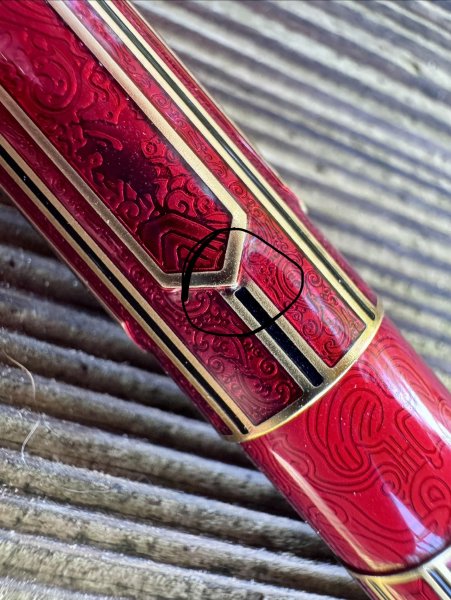
"So with this Viennese engraving sleeve, I have just noticed a small error, that is, our engraver Martin has made a small engraving with his tools, which was not a controlled engraving, but a slip and therefore we take it out. But Martin can rework it and then it's okay again."

Housings that are found to be in good condition are ready for the final production step, assembly. With so much manual labor ahead, employee Carmina had better not break anything during this final step.

"You have to be careful, yes, definitely, also that you don't scratch anything," she says. As a finisher, Carmina is responsible for the finishing work and assembles 100 to 200 individual parts a day. After six weeks of sawing, shaping, painting, engraving and checking, the handmade luxury ballpoint pen is finally finished. Waldmann produces 75,000 pens a year. Each one of these unique items is assembled before shipping.

"When you see a finished pen at the end of the day, you are extremely proud and full of joy, because we have put our passion and our love into it, and when someone gives it as a gift, even for yourself, I think that fulfills us at the end of the day.

How to write with the luxury product at the end of the day, our editor tests.

"I didn't think I'd ever hold such an expensive ballpoint pen in my hand, it does feel good to write with. At the end of the day, it's a ballpoint pen, but it's very impressive, especially now that I know how much work simply goes into it.


18:00 Schneider

Models with relatively small sales figures are also assembled by hand by the large manufacturer, but usually not by the boss himself. With very large numbers of pieces, the whole thing goes a little faster with this machine. 75,000 pens, the annual workload of the factory, can be produced on this line in one working week. Together with the stock, more than 3 million pens are shipped to 140 countries every week.

"When you actually hold the product in your hand and then you feel pride for sure. When you make ballpoint pens for the masses, of course you always have in mind that you actually want to make a good, favorable product for every user, and the one in everyday life is just always suitable for different situations."

Notes, school samples, shopping lists, our editor also tests the mass-produced product in practice "It actually writes quite smootly, also lies well in the hand, a good everyday ballpoint pen."

Just under 4 euros, just under 400 euros, we wanted to know where the differences are. Expensive materials and handcrafted production make the manufactured product a luxury item, while large quantities and affordable materials make the plastic pen an everyday product - but in the end, both produce blue lines on paper.


Link to comment
Share on other sites

  • Replies 0
  • Created
  • Last Reply

Top Posters In This Topic

  • mke

    1

Popular Days

Top Posters In This Topic

Create an account or sign in to comment

You need to be a member in order to leave a comment

Create an account

Sign up for a new account in our community. It's easy!

Register a new account

Sign in

Already have an account? Sign in here.

Sign In Now


×
×
  • Create New...