Jump to content

Fancy fountain pen for letter writing


cynegils

Recommended Posts

Hi all, I'm fairly new to fountain pen writing so I need some advice.


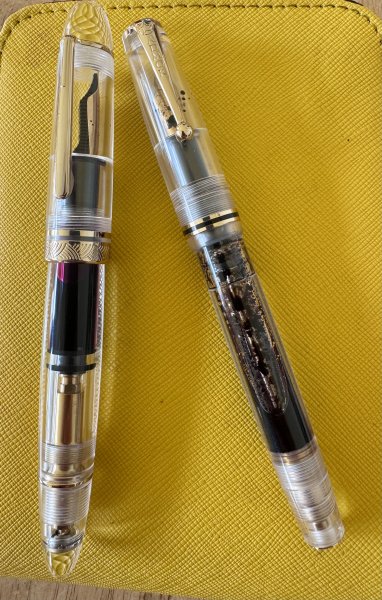
I'd like to buy a fancy fountain pen for writing letters. What does that mean? It has to be beautiful, write easily, give me line width variability without effort, and not tire my hand after writing for hours.


I admit there is a definite snobbery component to this. It has to look great. I like big nibs, big bodies, gold trims (two tones) etc and I'm willing to spend some money on it. However, it HAS to be comfortable. Now this is the part I'm more unsure about since I don't know what contributes to this. I'd expect size, weight, weight distribution, nib types, (etc) to be important, but I don't know how these correlate with comfort. I've tested different sized pens, but I find it hard to determine how writing a few lines compares to writing for a few hours (I write long letters). I understand that all this will be highly dependent on hand size, writing styles, etc, but I was hoping to hear some experiences. I also understand some of the cheaper modern fountain pens are ultra comfortable and wonderful writers, but as I said there is a snobbery component to this purchase.


Ideally I would love line width variability. I can create this by slowing down and pushing and pulling at the indicated moments. However I was hoping to write quickly and lightly without having to think about this, and see at least some evidence of line width variability. Therefore I'd expect nib grinds to play a role here.


So ultimately, anyone have recommendations, experiences? If not, are there any generalizations I could use for guidance? I.e. do bigger pens tire the hand more (is it as simple as that)? Do nib flexibility or nib grinds affect comfort in long letter writing?


Thanks all,

Cynegils

Link to comment
Share on other sites

  • Replies 35
  • Created
  • Last Reply

Top Posters In This Topic

  • Bo Bo Olson

    9

  • inkstainedruth

    4

  • cynegils

    4

  • BaronWulfraed

    3

Unfortunately, only you can make the decision about size/weight and what a pen looks like.  My largest pen is a vintage Sheaffer Balance Oversize, which is lighter weight than you'd expect from the size.  But it doesn't have a very expressive nib, and is also basic black (it used to be my husband's grandfather's pen, and it is a nice writer if just a basic F nib).  My heaviest pens are a couple of TWSBIs -- a 580-AL and and 580-ALR (at 28 grams, capped, they're about the limit of what's comfortable for me to use for more than a few minutes: I have small hands, so I don't tend to like overly large or heavy pens).  And I also tend to favor less expensive and/or vintage pens; I don't know what your price point would be (mine has certainly gone up since I started here as to what is "affordable").  My first "good" pen was a $9 US Parker Vector, which -- at the time -- seemed to be the height of extravagance, especially since I was ONLy using a fountain pen for my morning page journal!  But now?  I sign checks, draw, write poetry and am trying my hand at fiction, as well as making notes for research projects.  I ALSO make shopping  and "to do" lists, and cross out the bar codes on misdirected mail as "No such person at this address"....  Because, well, they're pens....  Just more fun to write with than a ballpoint. :P

For "beauty" there's nothing like some of the Japanese maki-e pen designs.  But they're super pricy, and I personally can't use one because the uruishi finish is made of the same stuff that is in poison ivy (and I'm super allergic to it; other people don't seem to have a problem, though, so it's a case of YMMV).  I think they might also be large and heavy pens in some cases.

If you want some line variation, you may want to look at pens which have italic or stub nibs as an option, or look at older/vintage pens with have some give or flex to the nib (you won't have as many options with modern pens but there are some: an older model Pelikan M400 can have very springy (if not precisely flexible) nibs (while possibly slimmer than what you want) a modern Pilot Falcon with a "soft" nib.  

If you're doing a lot of writing, you might also want to consider the fill system (for instance, look at piston pens rather than c/c pens because they tend to have larger capacities than converters or even cartridges -- because you're basically filling the entire barrel).  And also have a look at vintage pens, like the larger size Parker Vacumatics (which have some really beautiful celluloid barrels and caps, and -- again, hold a lot of ink in the barrel due to the fill system -- but might need to be restored in order to write).

I suggest that you look at sites like Goulet Pens, in order to get technical specs (such as size and weight -- both capped/posted and uncapped) for the pens.  If you live someplace which has a stationery store in the area (or even an actual pen shop) go in and ask to see some of what they have to see how comfortable they are too hold (smaller pens will, tend to cramp your hand up; heavy pens -- particularly with metal barrels -- will cause fatigue).  And I'd recommend that you might want to start with inexpensive pens and work your way up till you figure out what you like and don't like (some people find the step-down from the barrel to the section on a Pilot Metropolitan uncomfortable; some people don't like metal sections; some people sneer at pens like Lamy Safaris -- and the afforementioned Vectors -- for being "school pens", while others will be going "You paid HOW MUCH for that ugly MB LE pen?  Are you nuts?").  Ignore them.  You find what works best for YOU.  My favorite pen is a user grade Parker 51 Demi from 1949; my most expensive pen is a Pelikan M400 Stresemann.  And my best "sumgai" purchase was a Parker 41 that I paid 50¢ for at an estate sale and (although I missed the episode) was one of the two pens that got me my fifteen seconds of fame a few years ago at an appraisal show like Antiques Road Show only local -- showed the TV reporter and camera crew that pen and a 1926 Parker Duofold ringtop marked "Lucky Curve"; thought that the "big deal pen would be the Lucky Curve because it was so old, but nope -- the appraisal value on the 41 was about 100 times (or more!) what I'd paid for the pen 24 hours prior, while digging through a shoebox full of mostly ballpoints....

Ruth Morrisson aka inkstainedruth

"It's very nice, but frankly, when I signed that list for a P-51, what I had in mind was a fountain pen."

Link to comment
Share on other sites

23 hours ago, cynegils said:

I'd like to buy a fancy fountain pen for writing letters. What does that mean? It has to be beautiful, write easily, give me line width variability without effort, and not tire my hand after writing for hours.


23 hours ago, cynegils said:

Ideally I would love line width variability. I can create this by slowing down and pushing and pulling at the indicated moments. However I was hoping to write quickly and lightly without having to think about this, and see at least some evidence of line width variability. Therefore I'd expect nib grinds to play a role here.


You won't find a "wet noodle" nib on any modern pen, in my experience. Most of the pens that sport "flex" nibs tend to require deliberate pressure to produce width variation -- more pressure than I am comfortable with! I use fountain pens because, in proper condition, they write with practically no pressure applied -- thereby saving my fingers and hand from strain when writing anything longer than a word or two (which is why I don't use plain ball points, and even some fluid ink roller-balls take a touch more pressure than I like for long sessions).


A stub or small (cursive) italic nib provides line variation -- but it is fixed by direction of the stroke relative the angle of the nib). Avoid "formal" italic -- those are chisel edges and can not really be used at high speed; any rotation/tilt of the pen to the surface of the paper will result in the corner of the nib cutting into said paper.


Some nibs are branded as "soft" -- these are not "flex" nibs, just that they have a bit of give and "bounce" against the paper, vs a "hard" nib.

Link to comment
Share on other sites

Are you near any brick and mortar pens stores?  You really need to hold a pen in your hand to see if it's comfortable as I found that I can't just go on specs alone.  While you won't be able to tell how comfortable it would be during a long writing session, it's a great starting point.  I've tried several pens at stores and shows that I thought I would like, only to realize almost immediatley the pen didn't fit my hand.


My most comfortable pen is my Montblanc 146.  I have a .56mm crisp italic nib (ground from the Montblanc medium in it) that was custom ground by Lynda Kennedy of Indy-Pen-Dance http://www.indy-pen-dance.com/nib-work.html .  I print and tend to write slow so the crispness doesn't snag the paper or get in the way.  I really like to line variation I get from the crisp italic.


Hope this helped.

Link to comment
Share on other sites

If you want line variation without thinking, get a Stub.  But not on the fancy pen until you have experienced several (yes, because there are different tip sizes).


or at your peril, skip the learning and discovery part of your journey, and buy a Montblanc 149 with the Calligraphy nib.  

Link to comment
Share on other sites

Pelikan medium-long standard width 400nn, in tortoise to take care of beauty. A great balanced when posted as it should be.

Nib is semi-flex......and that era's '50-65 is the only oblique worth buying.

That era Pelikans are factory stubs in the 140, 400&400nn. Which is one of the reasons those nibs are so :puddle:.


It only took me a year or two to rate the 400nn over the 400.....again only the '50-54.....and that too can be had in tortoise.

Look up Pelikan Tortoise.

'50-65 140/400/400nn have semi-flex stubbed nibs, which is what you want. The medium-short 140 has a long cap and posts as long as the 400, and all three are of standard width. The 400nn is a tad longer getting into the medium-large range.

All have great balance, great nibs, and write with a Clean Line.


Nail = 0X tine spead. Like a P-51 or most modern pens.

Semi-nail, can be mashed to 2 X. Like a P-75.


Back in the Day of Black and White TV regular flex use to be regular issue.


Regular flex like on the great 200's nib, semi-flex and the rarer found mostly on Osmia pen's maxi-semi-flex are all in a 3 X tine spread set. Though I do have a couple Pelikans with maxi-semi-flex nibs....that is for later unless you luck out. In only the Osmai can you hope to get a maxi-with a Supra nib........6 weeks ago, I'd stated they were all maxi.....but two guy, on I respect a lot and a newer to me guy with a small collection of only 30 Osmias to my 8, said there are Supra nibs that are only semi-flex.


Now back to the my system of nib flex.......(going to leave out superflex....in you are Not Ready for that.....and requires lots of practice drawing letters before it can really be used.)


Regular flex can be mashed to 3 X a light down stroke...can't write with it so mashed but is part of my standard nib flex method limits. A nice smooth springy comfortable ride.


The flair nibs below. They give you that old fashioned fountain pen script with out you doing anything or having to write slow.

I had wondered for years why folks always said semi-flex made them write slow...until......I discovered they were practicing Nib Abuse. (I've posted on that with pictures.)


Semi-flex, requires half the pressure to mash the nib to 3 X as a well mashed regular flex. Semi-flex is strong enough to withstand the Ham Fisted.....only took me some 6 weeks to stop mashing the nib to the max all the time.

With a lighter hand,you can get Line Variation On Demand.

Normal line variation comes from where you naturally press harder on a letter, like the loop of a b or l....and any other letter that has a bit of start pressure. As one lightens up in the letter the line thins naturally. So you don't have to do anything at all. no finger or arm twisting, nor hanging from the chandlers. 

Once your Hand is a bit lighter, you can demand more line variation, like on the descender at the end of a paragraph, or a nice flared T crossing.


Maxi-semi-flex, requires half the pressure of a semi-flex to get to 3x or 1/4th the pressure of a well mashed regular flex. Fairly rair, my guess is 1 in 5 'semi-flex's are maxis, but they are not marked on any German brand, but Osmia, and that is not as sure as I once was............so that is pure luck of the draw.


Do Not mash any of the three past 3 X...........they are Not Superflex.

Semi=almost. Semi-flex, not semi-flex. It is a flair nib, not a calligraphy nib.

Many see only the part of the word that says flex, and they try to spring the nib. The repair of a sprung nib costs $$$$ and the nib is never as good as it once was.

On youtube and Ebay sellers show over stressed semi-flex nibs; pre-sprung for your convenience. So stay away from any extra wide writing examples on Ebay.


Do go to Richard Binder's site, and there is an article on metal fatigue. There is tree days of reading there and I go back to visit. 96% of what I once knew I got from there. Now it's only 92%, but in a decade; I should have learned something.


IMO You are not ready for superflex unless you get an Ahab and have the half moon Pilot/Ahab mod done to the hard semi-flex nib...and it is hard ..not easy to get even semi-flex tine spread; a weightlifter's spread.  With the mod it becomes a Easy Full Flex; the first stage of superflex.:thumbup:


Buy that not expensive superflex pens, until you know you will do the work and practice learning how to draw letters of copperplate or Spenserian scripts. The Ahab Mod does that trick.

I lucked into some superflex nibs, and after I read Richard Binder's (Once one of The Big Three, until he retired), I strive to stay under the max....that requires a few lesser semi-flex nibs to understand how much is a max in superflex. Or that modded Ahab.


I have a Pelikan 100n superflex, that will go 5x, I strive to stay at 4 X or lower.

Shown often on youtube and Ebay sellers....sprung nibs that go 7 X a light down stroke. Real undamaged superflex nibs that can go 7x and quickly recover are Rare. Rarer than those Nib Abusers show you. The quick recovery of a superflex nib is what those (not me) who can really write want....not how fat can I make a letter.

I have two 7X superflex nibs, and I do strive to stay at 6X or lower. Don't want to hang my head in shame, ya know.


Do get a pretty 400/400nn Tortoise from '50-65.


Then you get more flair from a F than a EF, more from a m....and a B is a writing nib in that era.

I've got a real nice semi-flex  :puddle: B on my '54 400. I've had it on my 605  also.

OH, yes......you can swap nibs on a Pelikan 400/600. (doing so with a 140's nib looks a bit dorky. In it's a smaller nib)  So you don't have to buy a new pen, when you buy a vintage nib.....not cheap....but you can always buy a vintage second pen with grand semi-flex nibs, the 140 or the 400's are Grand pens.


I have some 35 semi-flex, 15 maxi's, which are not for sale.


Do try German Ebay....before the Used $$$ Expensive Pen Cartell got into the game, a '50-65 era 400/120 cost E 100-120.....now the Buy Now Idiot for $285 sellers have put the same pen in the regular auction for $270; so everyone and his brother have jacked the price to match. Hunt, hunt, and have fun doing so. Look in the sold item section to see the real prices.

You must have Paypal, and the seller must ship to your country. There are some local yokels that don't have paypal nor mail out of Germany..........some trust only German Post. Some cut off their nose not wanting to pay paypal costs. So is the world.


The Reality Show is a riveting result of 23% being illiterate, and 60% reading at a 6th grade or lower level.

      Banker's bonuses caused all the inch problems, Metric cures.

Once a bartender, always a bartender.

The cheapest lessons are from those who learned expensive lessons. Ignorance is best for learning expensive lessons.


Link to comment
Share on other sites

Montblanc 146 w/B or BB nib(or OB/OBB if you really want to get adventurous) and don't look back.


Go with a 149 for the big nib "wow" factor, with the caveat that many folks find the 149 too large in diameter to be comfortable.


The nib size is key on this, as the large nibs are stubby-some more than others since they are all hand-ground and have sample to sample variation-but all still have varying degrees of stub character. Bs can run only a little bit to very noticeable, while I've never seen a BB that was anything short of an honest full blown stub.

Link to comment
Share on other sites

You will find that after to weeks of use, your hand will adjust to the pen you are using and it will be more comfortable. 


Like a new pair of shoes, you need to "wear the pen" so that is suits your style. 


Writing quickly and achieving line variation can be tricky. The flexing of the nib as you write will slow you down a little. 


With a stub, the pen has to be at the correct angle to the page to lay down the ink - or it will skip. This requires getting used to and can slow your writing down too.


The MB 149 with the caligraphy nib might be your best bet - if it is within your budget. It is large and has the nib you might want. If yo happen to live close to an MB boutique they should be able to let you try one out for free. That mught be a good place to start. 


At the cheaper end, a dip pen with a flexible nib might be as good a place to start as any.  You can try a flexy and a stub with very little outlay and see if they work for you. 


For fast writing (when I'm trying to get 1,000 words down in the space of a couple of hours) a hard nib works better for me that a stub or a flexible nib.  


There are many vintage brands such as Swan Mabie Todd which will probably give you the nib you want, but many vintage pens tend to be beautiful, but slender. 


Link to comment
Share on other sites

On 2/28/2021 at 4:22 AM, cynegils said:

It has to be beautiful, write easily, give me line width variability without effort, and not tire my hand after writing for hours.


All of that is so subjective, though. Without being you, and without you having been assessed in a clinical manner so as to specify (or ‘translate’) your requirements into criteria against which a pen can be objective compared, I don't know how anyone can meaningfully advise.


On 2/28/2021 at 4:22 AM, cynegils said:

Ideally I would love line width variability. I can create this by slowing down and pushing and pulling at the indicated moments. However I was hoping to write quickly and lightly without having to think about this, and see at least some evidence of line width variability.


There is line width variability (or ‘line variation’), and then there is line width variability. Both Italic and ‘Architect’ grinds will give line variation with no effort, as long as you hold the pen in consistent orientation while you write, but the manner in which the line width will vary is different from one nib to the other. I like what Italic nibs do, and hate what Architect nibs do, to my handwriting, and would rather write with a nib with a ‘perfectly’ round tip than an Architect nib. Exactly what manner of line variation are you after?


Then there are Zoom nibs, Fude de Mannen nibs (or Chinese ‘bent’ nibs), Naginata togi nibs, Aurora Goccia nibs, Santini Italia ‘Chinese calligraphy’ nibs, which are all designed to produce line variation in different ways when the angle and orientation of the pen changes.


Then there are nibs such as the ones on the Pilot Elabo, or FA nibs on Pilot Custom models, or Soft (SF, SFM, SM) nibs on some Pilot Custom and Platinum #3776 Century models which are ‘bouncy’ and provide line variation by moderation in downward pressure, which you may or may not have the skill and experience to control without conscious effort. In particular, the FA nibs much beloved by a significant subset of members of fountain pen hobbyist forums require light writing pressure; Pilot has clearly stated it's not suitable for users that write heavy-handedly (including implicitly anyone who press down hard to try to get some maximum line width for ‘flex’ writing), whereas the Elabo (aka Falcon) can withstand heavy downward pressure, but it will take more force to get the same apparent degree of line variation than when using an FA nib. On the other hand, the FA nib bends and produces a thicker line so readily that I find it difficult to control and produce exactly the sort of line variation I want; and it doesn't bounce back quickly enough to the finest line width. I suspect you'll need to train your hand to be able to write ‘fast’ with an FA nib, which makes it take more conscious effort, at least for the first several months or year.

I endeavour to be frank and truthful in what I write, show or otherwise present, when I relate my first-hand experiences that are not independently verifiable; and link to third-party content where I can, when I make a claim or refute a statement of fact in a thread. If there is something you can verify for yourself, I entreat you to do so, and judge for yourself what is right, correct, and valid. I may be wrong, and my position or say-so is no more authoritative and carries no more weight than anyone else's here.

Link to comment
Share on other sites

Go to....

Help! How Do You Hold Your Fountain Pen?


That is the forefinger up method of gripping a fountain pen, instead of the Classic Tripod. The tripod has many problems most folks take months to learn to have a light grip....Forefinger up is three minutes.

The over pressing at 10&2 is too natural in the Tripod.

The Reality Show is a riveting result of 23% being illiterate, and 60% reading at a 6th grade or lower level.

      Banker's bonuses caused all the inch problems, Metric cures.

Once a bartender, always a bartender.

The cheapest lessons are from those who learned expensive lessons. Ignorance is best for learning expensive lessons.


Link to comment
Share on other sites

I like line variation and I like writing long texts, including long letters. I don’t care so much for bling, though I love pretty pens. Over the years I found that vintage is the way to go for me. Especially vintage German pens may provide the writing experience you are after but maybe not what you call the “snobbery component”. The broader nibs usually were ground in a chisel shape and oblique nibs were very popular. Those provide effortless line variation and I have no problem to write fast and for extended periods. Those pens really were made for that purpose! Many of my champions wouldn’t be easy to find, so I keep it to what is amply available. Pelikan 400NN with OB or OBB nib would be my best bet. This is a very nice and robust pen with excellent nibs that is extremely balanced and has great ink capacity. It’s also quite affordable for what it is. If a Pelikan doesn’t do as a status symbol, you could try to find a Montblanc 144 or 146 from the 1950s with a similar nib. But I personally don’t like the Montblanc nibs as much as many other German makers of that period like Pelikan, Kaweco, Osmia to name only a few.

Link to comment
Share on other sites

For easy line variation I strongly recommend a stub. I have a TWSBI stub nib that I really like. However the pen it came on couldn't quite keep up with the nib's ink demands, possibly due to the plastic feed, so I transplanted it to a FPR Himalaya with an ebonite feed, and now it's my favourite "fancy writer". It helps that the Himalaya has no step and the threads don't bother me, making it quite comfortable in my hand.

Link to comment
Share on other sites

A stub or a CI is 100% line variation....a good thing to do to nail nibs. Therefor easier to use....but lacking the flair of  a good stubbed German vintage semi-flex.


Semi-flex is line variation on demand.....so one has to develop a lighter hand to be able to demand it....If you want more than what your normal handwriting will give you. ....stopping short of Nib Abuse...of course.


Many coming in from ball points or like me 40 years captive of ball points, have heavy hands. It took me some 6 weeks to stop maxing the 140 semi-flex OB nib to 3X, and perhaps that much time more before my hand was really light enough to Demand Line Variation' for fancy decenders or crossed T's.


The Flair is natural, where one presses the nib a bit more, the loop of a b or L, and other parts of letters where one naturally puts a tad more pressure in normal writing. That section of the letter will be wider than a nail. Flair with out effort.


Sooner or later everyone ...(out side a selected few here...who I do respect in they have gone into the wild and ran back to the air conditioned Nail home), deserves to enjoy a nice vintage semi-flex nib and it's natural flair.

The Reality Show is a riveting result of 23% being illiterate, and 60% reading at a 6th grade or lower level.

      Banker's bonuses caused all the inch problems, Metric cures.

Once a bartender, always a bartender.

The cheapest lessons are from those who learned expensive lessons. Ignorance is best for learning expensive lessons.


Link to comment
Share on other sites

If you know how to use a flex nib:


Montblanc with Calligraphy nib.


If you do not mind paying the price. If you do:


Frankenpen Jinhao with Zebra G nib. Will have to replace it every so, though.


If you don't:


Any light&fancy pen with an italic (if you know how to use one) or a stub (if you don't) nib. Or any light&fancy pen whose nib can be changed and change the nib for a stub or italic.


If you want really, really fancy, get an urushi maki-e fountain brush pen. That will give you a fancy pen, a fancy "nib", and as much line variation as you want.


The critical elements:

What is fancy for you?

Do you know how to use a flex nib?

Do you know how to use an italic nib?

Do you know how to use a brush pen?

What is "heavy" for you?

If you are to be ephemeral, leave a good scent.

Link to comment
Share on other sites

Thank you everyone for the thoughtful replies. I do realize most of this is subjective and it seems like I have things to figure about what is right (for me) but it has been very helpful to read about other people's experiences. From reading on other boards and places, it seems like I may actually prefer a stiffer nib, since I will be writing fast and for long periods of time. Also, based on the responses here, a cursive italic seems the way to go.


Right now I'm leaning towards a Pelikan M600 with a medium nib and ground down to cursive italic. I've read wonders about the M800, but it seems to be on the bigger side of things and I'm concerned about weight. I really like the fact that nibs on these pens are interchangeable.


Thanks again.


Link to comment
Share on other sites

The M600 is a good choice. 


Be careful - these Pelikans have been known to breed. 


You start with one - and before you know it, you have a whole flock.


Link to comment
Share on other sites

Great pen, and will take the fantastic 200 springy regular flex nibs.

A good comfortable ride, and the nibs are not terrible expensive, the cheapest....and had me pondering....but I have my 200's nibs, is Cult Pens in England....for the gold plated 200 nibs. Cheaper than Germany.

Gold plated will last many years if you don't take harsh paper towels to it.....soft flannel cloth would be enough for once in a blue moon cleaning.

The B is still semi&vintage width so is a writing nib. For Shading Inks I like M&B........F will do also.................

So buy your 600, get your nib grind, get the B, so you can make it a wide M or middling M......

Or if you start with M you can get your CI in F.

I think getting a CI in EF is a waste of spiffy, in you'd have to look hard for it.


Do Not waste money in a modern post '65 Oblique. Only the stubbed semi-flex obliques from '50-65 are worth while and will be well worth the money............but by that time you might well be in the market for a '50-65 400/400nn.

German E-bay if you Hunt you can get a decent price....but now it requires much will to spend no more than E-100, 120 max for a 400nn.......and tortoise costs just as much as green stripe.

Do Not use Buy Now Idiot, with Stateside prices....even on German Ebay. Why pay $285 for a E100-120 pen?

The Reality Show is a riveting result of 23% being illiterate, and 60% reading at a 6th grade or lower level.

      Banker's bonuses caused all the inch problems, Metric cures.

Once a bartender, always a bartender.

The cheapest lessons are from those who learned expensive lessons. Ignorance is best for learning expensive lessons.


Link to comment
Share on other sites

21 hours ago, sandy101 said:

The M600 is a good choice. 


Be careful - these Pelikans have been known to breed. 


Damn it! My wife is already ahowlin' and ahollerin' about silly pens... I'll make sure not to buy a female, but your post implies these may reproduce asexually. 

Link to comment
Share on other sites

18 hours ago, Bo Bo Olson said:

Great pen, and will take the fantastic 200 springy regular flex nibs.


This is an excellent idea. So only the M600 takes these nibs and not the M800?  Also, I read a review stating that Pelikan Souverain pens tend to write much wider than others, and that if I'm looking for a medium (for example), I should really be shopping for a fine.  Has this been your experience?

Link to comment
Share on other sites

Create an account or sign in to comment

You need to be a member in order to leave a comment

Create an account

Sign up for a new account in our community. It's easy!

Register a new account

Sign in

Already have an account? Sign in here.

Sign In Now


×
×
  • Create New...