Jump to content

An Ink That Doesn't Bleed Through Harland Checks


corgicoupe

Recommended Posts

Some time ago I posted that all my inks were bleeding through my latest Harland checks, regardless of the pen I used. The inks were

Pelikan 4001 blue

Sheaffer blue

Waterman blue

Parker blue

Private Reserve American Blue


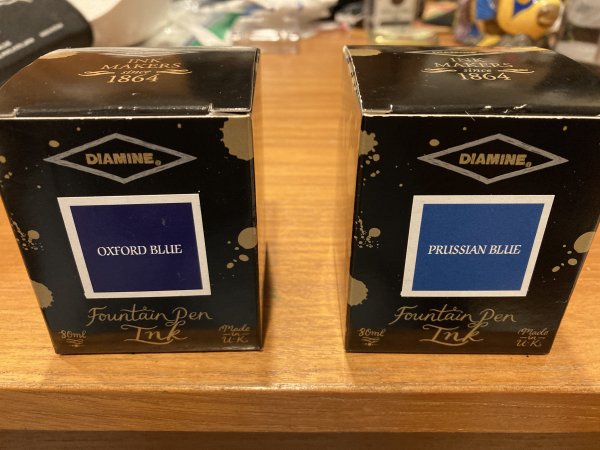
Someone in our local pen club suggested I try Diamine blue/black Archival Registrar's Ink. I have found that this one is the best I have come across. The Harland check paper is worse than printer paper for bleeding.

Baptiste knew how to make a short job long

For love of it. And yet not waste time either.

Robert Frost

Link to comment
Share on other sites

  • Replies 21
  • Created
  • Last Reply

Top Posters In This Topic

  • yazeh

    2

  • corgicoupe

    2

  • LizEF

    2

  • BaronWulfraed

    2

Good to know. I always have a pen loaded with this or the similar Hero 232. Great for addressing envelopes that might get rained on. I hardly write any checks now days-- maybe one a year. I was a slow adopter but now do everything through my bank's pay system or put on a credit card.

“Travel is  fatal to prejudice, bigotry, and narrow mindedness, and many of our people need it sorely on these accounts.” – Mark Twain

Link to comment
Share on other sites

FWIW, R&K Salix does really well on absorbent paper, as do Sailor Seiboku and Souboku (but Salix is a bit better).

Link to comment
Share on other sites

A finer nib would help on lower quality paper. I reserve a Pilot F or EF pen for lousier paper.

Link to comment
Share on other sites

I have found, and I have each of the inks you named, that my best ink for not bleeding or feathering on cheap paper is Diamine Grey. And it is additionally somewhat water resistant.

"Are we at last brought to such humiliating and debasing degradation that we cannot be trusted with arms for our defense? Where is the difference between having our arms in possession and under our direction, and having them under the management of Congress? If our defense be the real object of having those arms, in whose hands can they be trusted with more propriety, or equal safety to us, as in our own hands?" Patrick Henry

Link to comment
Share on other sites

A finer nib would help on lower quality paper. I reserve a Pilot F or EF pen for lousier paper.

My nibs are generally fine to extra fine for writing on checks, so the ink was the major problem.

Edited by corgicoupe

Baptiste knew how to make a short job long

For love of it. And yet not waste time either.

Robert Frost

Link to comment
Share on other sites

Part of the problem, though, is that Harland, like pretty much all check printers, is printing on very thin paper stock these days. I used to use a Conklin Heritage fine point with Herbin Perle Noir and it worked out just fine. Nowadays it bleeds right through, and the check paper itself feels much lighter than before. Don't even get me started on the registers.


I guess what I am trying to say is that given the times, when writing paper checks is going the way of stone knives and flint arrows, I don't see anyone printing on heavy enough stock to NOT show some bleed through. It's frustrating, I am still a dedicated check writing Luddite and likely always will be.

Link to comment
Share on other sites

Sailor Sei-Boku is my go-to ink to write my return address on super crappy envelopes that come with utiltity bills. I'm absoulutely not kidding when I say they are nearly as absorbent (just not as thick and soft) as actual blotter paper.


Sei-Boku handles it perfectly. Plus it's pretty water proof.


Speaking of ... since these are checks, even if 4001 did behave nicely, I would not use that to write checks. Can't speak for the others on your list.


-k

Link to comment
Share on other sites

I used to have Harland checks. The latest bank, they acquire each other so fast these days, seems to be using some company called Deluxe. The Deluxe checks are junk in every way. They claim to be Safety Checks, but I have to wonder since the checks are simply a uniform gray and I have to wonder if tellers would be able to see an attempt at check washing at all with them.


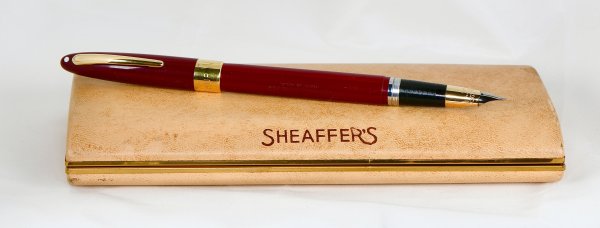
Anyway, for the past 16 years I have used Noodler's Black ink in a Sheaffer Imperial IV fountain pen with a medium nib for all checks. I have not had bleed through problems, and I know that any crooks that get ahold of them aren't going to be able to wash my checks. Also, the Noodler's Black ink is quite black and I can read what's written on the check even through the checks are a fairly dark gray. Writing checks is one of the things that Noodler's Black was invented for.

On a sacred quest for the perfect blue ink mixture!

ink stained wretch filling inkwell

Link to comment
Share on other sites

It must be at least 10 years that I last used a check!

My Volksbank stopped issuing them two or three years ago and the Postbank still has them but is constantly raising transaction fees.


No one uses checks in Germany anymore.

Eurochecks were quite handy to help you when you ran out of cash or needed more money than planned;

but nowadays you can get cash at multiple ATMs or even at your local supermarket.

(Or you can pay with credit card or even the banking card).


For paying bills we use our banking system: we don't have to send checks by snail-mail for the receiver to carry to his bank:

we just send the money from our bank to the receiver's bank directly.

That even worked before the internet: you had to fill out a form ("Überweisungsvordruck"), sign it and give it to your bank,

and the bank sends the money to the receiver's bank.
Nowadays we use online-banking for that, but the paper-version still works.


In effect it's like sending a check, but without the delay via mail and wihout the risk of the check getting stolen on the way.

Link to comment
Share on other sites

I wouldn't expect there to be any business value in check providers using FP-friendly paper: the number of customers that care about that is probably nowhere close to enough to justify increased cost in materials. I would expect they source paper as a commodity: whatever they print your checks on this year is no indication of what they print your checks on next year, or even next month, or even of checks printed today in a factory that serves a different region.


Nowadays we use online-banking for that, but the paper-version still works.


In effect it's like sending a check, but without the delay via mail and wihout the risk of the check getting stolen on the way.


I have no idea how it works in Germany/Europe, and I think it's probably more technologically recent than in the US. Here, doing a bill payment online usually sends a check: the banks print a check, the check gets mailed. Most banks outsource the check printing to a handful of specialized companies, whereas a few banks (Chase comes to mind) will print their own. Typical exceptions are if payee where a large portion of people all send regular checks to the same place, like a utility company. Those will result in a relationship between the utility and the bank such that payments really are sent electronically.


The system usually works well enough that most people remain oblivious to the fact that it's paper checks.


And to be clear, I'm talking about payments that people initiate through their bank. It's a completely different process (and electronic) if you enter your routing number and account number with the payee such that they pull money from your bank account.

Link to comment
Share on other sites

When the checks provided by my bank became such poor quality that the joy of using favored fountain pens & ink made it impossible I began using a Kaweco green celluloid ballpoint (made by Visconti) that I had purchased when I found a set including the fountain pen @ a price affordable to me. I had purchased the set FOR the fountain pen & had just ignored the ballpoint Sport. Fitting it with a refill gives me the opportunity to utilise something I already owned & since the celluloid is so handsome I find I am happy to use it.


I had fought, pleaded with the bank & realised I was fighting a losing battle; there are simply not as many paper check Customers for them to consider our preferences. Life is too short for me to fight a battle I will not win. I had after all written checks with something other than a fountain pen for years past so it was not as though I had to learn a language foreign to me!

Link to comment
Share on other sites

OK, bizarre (sort of), but one reviewer even mentions using a FP:

https://www.amazon.com/dp/B0176OVUPG


I buy laser printer checks (3-up, personal size) and they do well with FPs, but I haven't bought any in eternity (I only have to use one check per year now), so maybe that's no longer true...

Link to comment
Share on other sites

Secure Premium Voucher Checks for Quickbooks and Quicken are printed on better quality paper.


https://intuitmarket.intuit.com/spvcpremier


There is some slight bleed-through, but no feathering with Pilot Blue-Black or Sailor Souboku.


I print an average of three checks a month, so a small supply lasts a long time.

Rationalizing pen and ink purchases since 1967.

Link to comment
Share on other sites

I have had good luck with R&K Scabiosa, R&K Salix, Diamine Grey, and DeAtramentis Document Black on checks and crappy envelopes. In that order. I still write a fair number of checks, to service people like my horseshoer, but I also pay such things as utility bills that way, because I find that once I have automatic payments I no longer pay any attention.

Link to comment
Share on other sites

I run about 6 checks a month -- but all from VersaCheck printed blanks, filled in via Quicken. The only field that sees a pen is the signature line... And, personally, I don't care about bleed-through at that location.


{Over $70 for a 50 pack of Voucher checks? Yeesh, here I was complaining about paying half that for pack of 250 sheets of 3-up personal checks}

Link to comment
Share on other sites

I was wondering what difference does it make if an ink bleed through a check? Is it the aesthetics of it?

Link to comment
Share on other sites

I was wondering what difference does it make if an ink bleed through a check? Is it the aesthetics of it?

Depending upon where, it could obscure the endorsement region, and/or the bank stamp area (presuming the bank doesn't just scan/shred* the check before applying processing marks -- after all, many banks have added phone apps that allow one to photograph both sides to deposit it, so a physical check never enters the banking system)


* this is also why I haven't bothered with an expensive VersaCheck check printer and MICR ink. I suspect modern processing uses optical scans, rather than routing paper via the MICR encoding.

Link to comment
Share on other sites

Depending upon where, it could obscure the endorsement region, and/or the bank stamp area (presuming the bank doesn't just scan/shred* the check before applying processing marks -- after all, many banks have added phone apps that allow one to photograph both sides to deposit it, so a physical check never enters the banking system)


* this is also why I haven't bothered with an expensive VersaCheck check printer and MICR ink. I suspect modern processing uses optical scans, rather than routing paper via the MICR encoding.

Thanks....

Then they must be using blotting paper for checks..... :)

Link to comment
Share on other sites

Create an account or sign in to comment

You need to be a member in order to leave a comment

Create an account

Sign up for a new account in our community. It's easy!

Register a new account

Sign in

Already have an account? Sign in here.

Sign In Now


×
×
  • Create New...