Jump to content

Any "hacks" For Metal Grips?


Erggg

Recommended Posts

I have a pen with a metal grip. I love the pen but hate how the grip is so slippery. Is there any way I can make the grip less slippery for longer writing sessions? I'm open to any and all ideas.


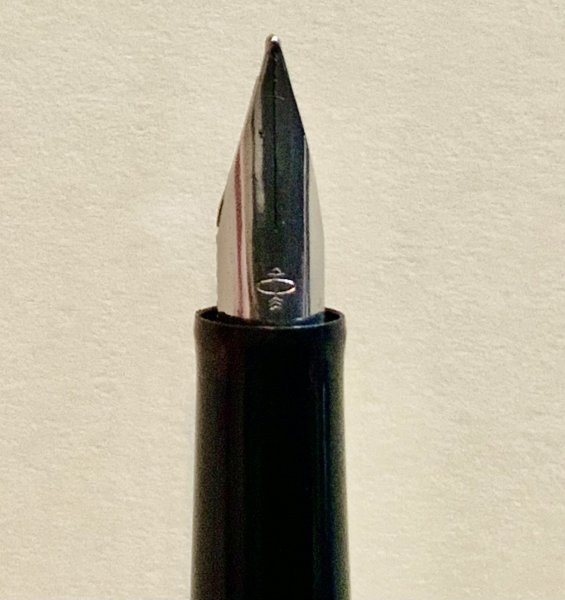
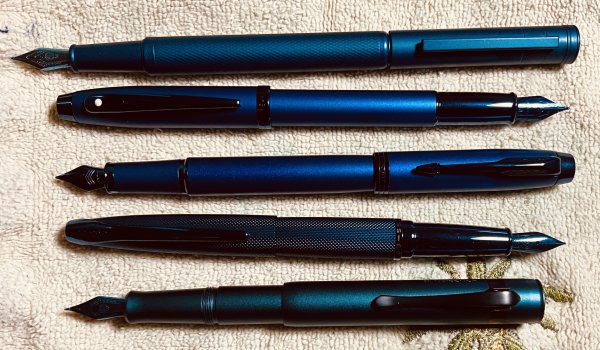
I also provided a picture of the pen in case people need to see what I'm working with (I have no idea what the name of this pen is).


post-140758-0-15218100-1551930142_thumb.jpg

Link to comment
Share on other sites

  • Replies 31
  • Created
  • Last Reply

Top Posters In This Topic

  • Honeybadgers

    6

  • A Smug Dill

    2

  • Erggg

    2

  • OCArt

    1

Top Posters In This Topic

Posted Images

I've always wanted to try bead blasting a metal section. Might be tricky to do, but would probably be awesome...

Link to comment
Share on other sites

There is something called plastic-dip that folks use to coat tool handles. Seems to be sold at hardware stores. I wonder.....

“Travel is  fatal to prejudice, bigotry, and narrow mindedness, and many of our people need it sorely on these accounts.” – Mark Twain

Link to comment
Share on other sites

I've always wanted to try bead blasting a metal section. Might be tricky to do, but would probably be awesome...

I also thought about taking my Aurora 88 Sigaro Blu to a jeweller and have him/her either bead-blast or sandblast the glossy chrome section for me. However, the hassle and the cost are (imagined, not assessed) deterrents, and as it turn out after I've used the pen for a bit, I find myself naturally holding onto the threads on the section, so the slipperiness of the glossy section does not actually pose a problem.

I endeavour to be frank and truthful in what I write, show or otherwise present, when I relate my first-hand experiences that are not independently verifiable; and link to third-party content where I can, when I make a claim or refute a statement of fact in a thread. If there is something you can verify for yourself, I entreat you to do so, and judge for yourself what is right, correct, and valid. I may be wrong, and my position or say-so is no more authoritative and carries no more weight than anyone else's here.

Link to comment
Share on other sites

I've been considering trying to apply some heat-shrink tubing to a metal pen I have. Haven't actually done it.

Link to comment
Share on other sites

I would really be interested in a solution, as much as I like my Lamy Studio the highly polished section is too slippery for anything more than a quick note.


Al

Link to comment
Share on other sites

I have a pen with a metal grip. I love the pen but hate how the grip is so slippery. Is there any way I can make the grip less slippery for longer writing sessions? I'm open to any and all ideas.


I also provided a picture of the pen in case people need to see what I'm working with (I have no idea what the name of this pen is).


attachicon.gif Pen - Colorful Green Lines.jpg

If you have no qualms about modding that pen irreversibly, I'd start by burnishing with fine sandpaper say 1000-1500grit unless you've got metal-brushing tools then I'd brush it to a nice diagonal crosscheck pattern :)


If it's still slippery I'd be tempted then to bust out the nail varnish box & give it a nice gloss coat of clear.

Link to comment
Share on other sites

I have the same dislike of metal sections and I HAVE used heat-shrink tubing with success a couple of times, but as Arkanabar mentioned, that solution CAN get in the way of whatever engages the cap. The times I've done it, it was simply a matter of cutting a narrow enough "slice" of tubing so as not to interfere with the capping process.

Keep in mind as you cut the tubing that (as its name implies :) ) you will end up with a smaller piece than when you made the initial cut.

Obviously, make sure the heat source you use to shrink it is the lowest possible temperature you can get to work.


Would post a pic but, luddite that I am, have had no success in trying to figure out how to do so.

Link to comment
Share on other sites

It depends, if it's an inexpensive chrome plated section, blasting will just remove it all.


I like Dill's idea of having a jeweler blast it though. I wonder if I could have that done with my conklin nozac. I'd use the ever-loving hell out of my nozac if it wasn't for the shiny polished section.


I've wrapped the section in a pilot penmanship with a narrow, thin strip (1/8in wide) of leather, and hooooooooooly (bleep) did it become the most comfortable pen I've ever used in my entire life. Shame I broke the pen. I have a buttload more leather. maybe I'll do it to another pen or pencil sometime. leather is so much nicer in the hand than any of those crappy gel or rubberized grips.

Selling a boatload of restored, fairly rare, vintage Japanese gold nib pens, click here to see (more added as I finish restoring them)

Link to comment
Share on other sites

It depends, if it's an inexpensive chrome plated section, blasting will just remove it all.


I like Dill's idea of having a jeweler blast it though. I wonder if I could have that done with my conklin nozac. I'd use the ever-loving hell out of my nozac if it wasn't for the shiny polished section.


I've wrapped the section in a pilot penmanship with a narrow, thin strip (1/8in wide) of leather, and hooooooooooly (bleep) did it become the most comfortable pen I've ever used in my entire life. Shame I broke the pen. I have a buttload more leather. maybe I'll do it to another pen or pencil sometime. leather is so much nicer in the hand than any of those crappy gel or rubberized grips.


Thats a really nice ideia


do you still have any photos of how it turned out ?

Link to comment
Share on other sites

I like Dill's idea of having a jeweler blast it though. I wonder if I could have that done with my conklin nozac.


Or one could try hammering, but I'm not sure whether it's possible to provide support from inside the hollow core of the section, and strike hard enough to create texture on the convex surface, without damaging any threads (for screw-in nib housing) and such on the inside.

I endeavour to be frank and truthful in what I write, show or otherwise present, when I relate my first-hand experiences that are not independently verifiable; and link to third-party content where I can, when I make a claim or refute a statement of fact in a thread. If there is something you can verify for yourself, I entreat you to do so, and judge for yourself what is right, correct, and valid. I may be wrong, and my position or say-so is no more authoritative and carries no more weight than anyone else's here.

Link to comment
Share on other sites

if you hop over to Hobby forums ( notably those doing scale modelling and similar ) sand blasting with a ( appropriate ) air brush is quite common and done using micro ceramic beads and there are specialist tools / blast & paint chamber that's tailor for the need .. you might wish to try to find some hobbyist who can access or having such to do a job. They generally and naturally are much more economical than having a jeweler's service .. you can google Airbrush Sandblasting and you would find loads of info regarding

Link to comment
Share on other sites

Or one could try hammering, but I'm not sure whether it's possible to provide support from inside the hollow core of the section, and strike hard enough to create texture on the convex surface, without damaging any threads (for screw-in nib housing) and such on the inside.


If the finish was chrome plated, I think that would be more prone to fracturing the chromium layer away from the base metal.


I think bead blasting and hoping you don't dig too deep or go too aggressively is the right track, which is why I think you're onto something by having a jeweler do it.

Selling a boatload of restored, fairly rare, vintage Japanese gold nib pens, click here to see (more added as I finish restoring them)

Link to comment
Share on other sites

The slippery section on my blue and black Lamy Studios didn't bother me, but eventually I realized I was gripping them harder than other pens, and using less and less. I took some sandpaper to them, following the instructions I found here. I messed up the first attempt, sanded too much, so the pen is now usable but not as good looking, managed the second one better. The trick is to go lightly with different grits, and take off the section ring first; of course each pen has different characteristics. Lamy could probably do a little extra money by selling additional sections for these pens that don't require a hack, as they are good looking, reliable pens with smooth nibs.


fpn_1550864632__studio_sanded.jpg


"The trouble with the world is that the stupid are cocksure and the intelligent are full of doubt."


B. Russell

Link to comment
Share on other sites

I should've mentioned that the pen was around 4$ on ebay. I am willing to buy a second pen to test some of these ideas. I'll probably start the plastic-dip route first since it seems less invasive. If that doesn't work I'll consider asking a jewler to sandblast it. I don't need the entire section to be grippy, just the part that I would rest my fingers.

Link to comment
Share on other sites

For a $4 pen... Use a hobby lathe to cut shallow grooves around the section, then roll a series of small o-rings into the grooves. If small enough (ring material itself, one would need a series of sizes to account for the taper of the section) they may only just protrude above the section giving a surface fingers can grip. The o-rings would hide where one has cut through the chrome layer (just don't cut so deep as to produce loose rings of chrome <G>)

Link to comment
Share on other sites

Create an account or sign in to comment

You need to be a member in order to leave a comment

Create an account

Sign up for a new account in our community. It's easy!

Register a new account

Sign in

Already have an account? Sign in here.

Sign In Now


×
×
  • Create New...