Jump to content

Kohinoor Rapidograph Repair


Larry Barrieau

Recommended Posts

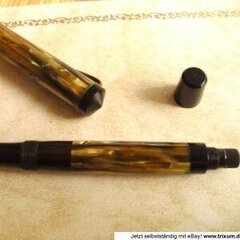
Hi, I got a box of pens and pencils recently and there were three of these in it.


They appear to be in good shape but I can't get them to write. I sonicated and soaked the nibs in water and ammonia for hours. The only thing I could find on the internet was for the newer pens, these I believe are from the 60's or 70's. Do they work like an ink-o-graph with the little sylus coming out of the tube?


Thanks for your help. They are nothing fancy but rather than getting rid of them, it would be nice to repair them.


Larry


Looking for a black SJ Transitional Esterbrook Pen. (It's smaller than an sj)

Link to comment
Share on other sites

  • Replies 15
  • Created
  • Last Reply

Top Posters In This Topic

  • Larry Barrieau

    3

  • Ron Z

    2

  • Pickwick

    2

  • balson

    1

Top Posters In This Topic

i have limited experience with technical pens but i can recommend rapido-eze as a good first step. it works great on fountain pens too, but it was designed to clean out the much more stubborn pigment based inks used it technical pens, like the lot you have.

Link to comment
Share on other sites

I would second the suggestion to try the commercial stuff that was made to clean those pens.

And be patient, those pens had a long headstart on you, to get dry and clogged.

San Francisco Pen Show - August 28-30, 2020 - Redwood City, California

www.SFPenShow.com

Link to comment
Share on other sites

I also have one of those. Can anyone tell me what the insides of these pens are supposed to be? I also have some ink for mine, so I hope to get it working again.

Link to comment
Share on other sites

It´s the same as an Inkograph only it´s a piston filler, with either a springy or weighted wire in the tip to turn on or off the ink flow. If you break the wire you can replace it with a

piece of .009 or slightly bigger stainless steel guitar string.


+1 on cleaning with Rapidoeze, it´s one of the only things that will clean them once they have sat for awhile.


ken

Link to comment
Share on other sites

The Rapidographs have a nib unit that unscrews from the barrel. They have a weighted wire inside that is supposed to extend out the end just a bit so that it is pushed up when you contact the paper, and then goes back down when lifted. The idea was to keep the pen from clogging when used with technical inks. If there is India ink inside, and often just dried FP ink inside, you have to remove and disassemble the nib unit to clean inside. Sometimes an ultrasonic just won't do it. Sometimes you have to use Koh-I-Noor pen cleaner, though you can try about 10 drops of Dawn Platinum with some ammonia. The combination works very well. BTW, modern nibs can be inserted in place of the originals like yours if it's broken. You find them at art supply stores and on eBay.


Soak, (you've already done that) then using a grippy pad, unscrew the cone that you see. It'll take quite a few turns. Once out you'll see the weighted end of the wire. Sometimes it's held by a plastic piece that slips in the end of the tube on the nib unit, sometimes its a thin metal strap. Take it out and pull out the weight and wire. Be very careful as you handle it. With the finer nibs like 00 etc. the wire is very thin and bends very easily. Straightening it can be difficult, break it and you're looking for another nib unit. (see above). Clean the wire in the ultrasonic - be careful, along with the nib. You may have to wipe off the wire. Flush and rinse the tube part with a desoldering bulb or ear syringe. Don't try to stick the wire back in - get the wire lined up and just inside the tube, then drop it, letting the weight set it in the tube. Put the retainer back in, and reassemble. Do not use any kind of sealant on the threads. Ink is drawn in through this area, which is why that deep spiral is cut across the threads.


You won't be able to run a brush or anything into the barrel from the front because most pens have a barrier there to keep the weight from falling into the barrel. You'll have to take the piston mechanism out to clean it. The piston mechanism unscrews from the back - red ring and all. Normal right hand thread. After cleaning, put a little (and I do mean LITTLE) silicone grease on a cotton swab, put some on the inside of the barrel and on the piston head. Reassemble.

spacer.png
Visit Main Street Pens
A full service pen shop providing professional, thoughtful vintage pen repair...

Please use email, not a PM for repair and pen purchase inquiries.

Link to comment
Share on other sites

I have quite a few of these, I really enjoy them...piston fillers with a MASSIVE array of points.


edit: whenever I buy one that isn't working, a good soak in rapido-eze (technical pen cleaner) will get the unit running again. If you are unable to remove the nib unit, try soaking in rapidoeze, and if that doesn't work, they used to sell nib-removal tools with each one of these pens (they are just a little circle with a flat spots that fit the sides of the unit).

Edited by Tadeusz
Link to comment
Share on other sites

Thanks very much. I'll try the Rapid o eze first and then try taking the nib off. It's tight and even with a grippy pad I can't twist the cone off. I'll work on it.


Larry


Looking for a black SJ Transitional Esterbrook Pen. (It's smaller than an sj)

Link to comment
Share on other sites

As an experienced users, my advice is to: NEVER pull the 'weighted pin' from the super tiny nibs, it's almost guaranteed than you will never get it back in. Once you've pulled it, you may as will get a new one.


I had a set of the Rapid-O-Graphs much older than the one picture. they had all been left in a locker in a print shop I worked in as a paste-up artist. I soaked all of them in Rapid-O-Eze for days and the small ones were locked in place with dried ink. The larger ones eventually soaked clean, but the little tiny ones that weren't frozen would not take the pins back in and bent. Before I knew better, I got P.O.'d and pitched them. Can't tell you how much I regret that move! Took me a long time to get a new set of my own for use outside of work.

Fair winds and following seas.

Link to comment
Share on other sites

The small points clogged with Indian ink never come clean - anything under .35 mm. You just can't get the ink out. But rapido-eze and ultrasonic cleaning will work with the larger points.

Link to comment
Share on other sites

Further to the above advice, I use a Koh-I-Noor 00 a lot. It will completely disassemble. When the blind cap is removed the piston knob can be unscrewed and I completely clean everything out of the barrel, after using acrylic and India ink. I haven't attempted taking the piston out.


Care does need to be taken reassembling because if the piston knob is removed it needs to fit snug on the piston before screwing back in. It just requires slowly turning the piston knob until it is reseated, and will then screw back in.

They came as a boon, and a blessing to men,
The Pickwick, the Owl and the Waverley pen

Sincerely yours,

Pickwick

Link to comment
Share on other sites

I've just taken mine apart and discovered the piston came out attached to the screw knob. In future it will mean I'll be able to clean out the barrel more efficiently.

They came as a boon, and a blessing to men,
The Pickwick, the Owl and the Waverley pen

Sincerely yours,

Pickwick

Link to comment
Share on other sites

Thank you. I am awaiting the rapido eze and I'll soak the nibs and if that doesn/t work I'll try to unscrew them and clean them that way. Am I correct in thinking that this model does not accommodate the tool that the newer ones have (I see no flat spots on the nib part.) , and that I will just unscrew the conical part near the nib?


Larry


Looking for a black SJ Transitional Esterbrook Pen. (It's smaller than an sj)

Link to comment
Share on other sites

The small points clogged with Indian ink never come clean - anything under .35 mm. You just can't get the ink out. But rapido-eze and ultrasonic cleaning will work with the larger points.


I disagree, and also disagree with the notion that you should not take the wire out. With the wire out and a desoldering bulb from Radio Shack, or an ear syringe, or even the end of a hypodermic syringe the cleaning solution can be forced through the tube in the nib unit.


Please re-read my post above. I've been working on these things for over 25 years now, both for myself and for clients.


Some of the pens from this era have flats on the side that allow you to put a small adjustable wrench on the flats to unscrew. Others do not, which is when a pair of section pliers or a grippy pad come in handy.

spacer.png
Visit Main Street Pens
A full service pen shop providing professional, thoughtful vintage pen repair...

Please use email, not a PM for repair and pen purchase inquiries.

Link to comment
Share on other sites

I, in turn, have been using and cleaning them since the mid-70's, and am in general agreement with Ron's cleaning technique. Mine is different, but his sounds good based on my experience with the pens. I will say that you do need to be very careful with the really small size points, but you can (and ultimately need to) remove the weight/guide wire in order to clean out the point. You just have to be delicate and work by feel when reinserting it. As Ron said, let it drop in by its own weight. If you bend the wire, you can usually "stroke" it straight again with your fingertips, unless you've made a really sharp kink.


Standardgraph used to make smaller points (e.g. 4X0, 5X0, 6X0) with unusually thin guide wires in relation to the wall thickness of the tube -- like a baby's eyelash. You really couldn't remove the wire on those and successfully reinsert them. They sold a pressurized can of special solvent-based foam cleaner, and the entire section screwed into the nozzle. That would work for a while to keep the point running, then you had to pitch it and buy another.

Edited by Tweel

fpn_1375035941__postcard_swap.png * * * "Don't neglect to write me several times from different places when you may."
-- John Purdue (1863)

Link to comment
Share on other sites

I must agree with Ron Z here I have worked with technical pens for many years. I have taken them apart and put them back together including the finest of wires.

Now I will also say, I have. some of my co workers can not get the fine wires back in.

It takes a very fine hand and some patience.

But it can be done.

Technical pens are great to work with once you learn how.

Link to comment
Share on other sites

Create an account or sign in to comment

You need to be a member in order to leave a comment

Create an account

Sign up for a new account in our community. It's easy!

Register a new account

Sign in

Already have an account? Sign in here.

Sign In Now


×
×
  • Create New...