Jump to content

Cleaning A Rapidograph Pen?


BullRunBear

Recommended Posts

Just received a set of Koh-n-Noor Rapidograph pens. I know they have to be cleaned often. Do you have to use the Rapido-eze (sp?) solution, which I don't have yet, or can I use distilled water or some home made solution? I use water and a squeeze bulb on fountain pens but don't know if that's proper for these technical pens. Any advice would be appreciated.


Thanks, Jeff

Link to comment
Share on other sites

  • Replies 13
  • Created
  • Last Reply

Top Posters In This Topic

  • FPFan

    4

  • BullRunBear

    3

  • zquilts

    1

  • ravantra

    1

I've my Koh-i-noor set for some twenty years. When I first bought it I did use Rapido-ez but now I just use my ultrasonic cleaner - after washing away as much of the ink as I can with plain warm water and a bit 'o' soap. I add warm water and touch more dish soap to the ultrasonic cleaner and let 'er go. Never had any issues - even if the ink had dried in the nib - which I once heard spelled death for the pen.


BTW - I love using Noodlers Polar black - or another nice, rich black of your choice, in these pens. Perfect pairing I think!

Enjoy!

<!-- isHtml:1 --><!-- isHtml:1 --><a class='bbc_url' href='http://www.musingcrowdesigns.com'>Musing Crow Designs

Link to comment
Share on other sites

Ultrasonic cleaner and Rapidioeze, soapy water or even plain water works.

Change is not mandatory, Survival is not required.

Link to comment
Share on other sites

I've had my set of 7 for over thirty years. Great tools! Which set did you get?


Because I've had mine so long, I don't have the paper work anymore, but I think there ought to be a description of how you disassemble the nib section for easier cleaning. The nib section unscrews from the feed system and I soak the two parts seperated. I do use the Rapid-O-Eze, but as stated above dish soap will do the job pretty good.


One of the key factors in using these pens is to NEVER let the ink dry in them. If you aren't going to use them for a couple of days (especially the really tiny size ones) clean them out. The ink is realatively cheap as compared to a new pen or nib section.


There is one more step of taking the nib apart, but it is not recommended with the really small size nibs (as in anything smaller than say 0.5mm. So, with the nib section out of the feed section, at the back of the nib part, there is a little clear plactic piece that holds the two pieces of the nib in place. You can see it move back and forth if you shake the section, you will hear it sort of rattle in there. It's a weighted piece of metal with an even smaller little "string" of metal (size relative to the nib size)this is something like a "flow regulator." In a really jammed up nib with dried ink in it you can remove this piece. But you have to be extremely causious with the ultra small little wire. If the little wire gets bent the nib will NEVER work again. (Just getting it back into the outer piece will bend the little tiny nibs wire, which is why you would not take it out. I've bent several just trying to put it back together. Those nib part are near impossible to find these days since AutoCad came along.) You can soak both pieces for as long as it takes to clear the ink off. An ultrasonic machine would definately help in this case. (I've never had one.) Once everything is clean and dry you put it all back together just like it came apart. It can either be very tedious or a lot of fun discovering the working parts of these little wonders of hand drafting/drawing fame.


This may be a little bit more than you wanted to know, but I thought you might need the information if you really get into these tools.


I will enjoy hearing about your experiences with them. They were a mainstay of my daily life back when. . .

Fair winds and following seas.

Link to comment
Share on other sites

This brings me back to the late 1970s and 1980s when my work was dominated by such pens and my fingernails had a permanent black frame. As FPFan advises, don't let the ink dry in a pen, especially if the nib is smaller than 0.5 mm (in my experience 0.3 mm). I used to be able to completely disassemble a 0.3 or higher and clean it thoroughly with just water. 0.2 and 0.1 were virtually impossible to repair.


A useful instruction sheet is available at http://www.kohinoorusa.com/sellsheets/service_policy.pdf but you probably won't need the syringe and cleaning solution if you clean them regularly with lukewarm water.

Link to comment
Share on other sites

Alexander_k - that's the instruction sheet I was refering to. In the all parts picture on the top of page 2 you can clearly see where the clear end cap is that if removed will expose the thin wire pieice. Thanks for that link. BullRunBear should have no problem with it.

Fair winds and following seas.

Link to comment
Share on other sites

Thanks to all for the great information. I'll pick up an ultrasonic unit this week and use warm water with a drop of soap that doesn't leave a residue.


I have a set of four pens in a case with a single in .25. My wife and I recently retired and knew we wanted to try sketching/drawing as a hobby, an interest we didn't have time for with our careers. A local art supply store was closing (the owner wanted to start his own retirement) so we were able to load up on a ton of stuff at 50 to 70% off, including these Rapidographs. Sometimes it helps to be lucky.


I'm encouraged by the folks that have used their Rapidograph pens for decades. That has real appeal for me. I don't mind the little effort to maintain them. For my creative writing I make notes with fountain pens and do drafts on manual typewriters. I appreciate tools that do their jobs year after year with a bit of TLC. Hmmmmm, there should be an essay in this comment.


Also, thanks for the mention of the Noodler's ink in these pens. I've been satisfied with Quink in fountain pens for many years. But the past year I've become a huge fan of Noodler's inks. Any excuse to order more of their colors is welcome. (Like I need an excuse to get more ink!)


Thanks again,


Jeff

Link to comment
Share on other sites

Congratulations on your retirement and on the great sale prices. It's always nice to have hobby that couples can share.


If either of you are going to use the ink drawings as a base for any wet media painting, you will want to stick to the Black India Ink that came with it. Even Noodler's bulletproof black with leave a little surface ink that doesn't get completely soaked into the paper thus muddying up your "watercolor"/painting. I also favor the Platinum Nano Carbon ink, not only in the Rapidographs, but in fountain pens with an extra wide ink feed cut. Jetpens.com sells an inexpensive Carbon Black pen that Platinum makes to use the nano carbon in. (No affliation)


Have a great time and keep us posted!

Fair winds and following seas.

Link to comment
Share on other sites

FPFan,


Thanks for the suggestion. I was going to order the Noodler's Black but after reading reviews of the Platinum Carbon Black, it is definitely the way to go. Even if I don't get the Carbon pen, God knows I have enough fountain pens to use if I'm on the road. For some reason, I do better sketching with ink than with pencil. (There's probably a doctoral thesis analysis in that.)


Jeff


PS: Retirement is WONDERFUL!

Link to comment
Share on other sites

If you do decide to get a bottle of Platinum's Nano Carbon (or anyone else's) for use in a standard fountain pen, make sure it is in regular use and flush it frequently. At the very least, every other fill-up. Use of Platinum Pen Cleaning Kit is a good servicable cleaner for this ink. Clears it out realy well. I used to use Rapid-o-Eze in my fountain pens, but recently learned it strips away the silicone greese on piston fillers, so I have tryiing to keep that out of those pens. Ever keep it out of converters, too. I ruined a couple of old Omas piston filler pens with it.


Now you know, an aweful lot of people sketch in pen and ink vs pencil. Remember old time cartoonists used dip pens and india ink for their work in Black ink. The last art class I took (2011) we were required to do sketches in ink at least once or twice. However, if you want to give that thesis a go, I'll read it! :lol:

Fair winds and following seas.

Link to comment
Share on other sites

  • 2 years later...

I just revived a bunch of Rapidographs that were in the back of my desk for a few years. I admit I got distracted and let the ink dry in them. I disassembled the pens and put them in the Ultrasonic spa for a little while with hot water and a cap full of ammonia. They work nicely now.

Edited by Talisheek
Link to comment
Share on other sites

Wow. I have a set but haven't used them for years. I got the basic set of four when I graduated from high school (asked for them, in fact) then bought a couple more sizes when I was in college. It wasn't until college that I found out they were for ruling, because the only person I knew in high school who had a set used them for drawing.

I just used Koh-i-Noor ink in them, for the most part, as I recall. I got in an argument with a guy I knew (not a student, but a guy who hung out at the campus coffee house on weekends) over what ink to use. He was of the opinion that Koh-i-Noor was too grey, and that I should be using something like Higgins India Ink, but I liked the grey tone for drawing with. In retrospect, of course, india ink might have been a really bad plan....

I wonder how much cleaning I'd have to do on mine. :blush:

Ruth Morrisson aka inkstainedruth

"It's very nice, but frankly, when I signed that list for a P-51, what I had in mind was a fountain pen."

Link to comment
Share on other sites

  • 2 weeks later...

@inkstainedruth -

One of my rapidographs sees regular use, but another one I apparently forgot about for a while, oops. The rapidograph ink had dried and it wouldn't write at all!

I found this video to be really helpful.


https://m.youtube.com/watch?v=QSRo5lUn7bM


Especially since I substituted the "syringe" for an ear bulb that I had trimmed too high for my fountain pens. And I just used water, not their cleaning solution. But I bet alcohol would work on the India ink.


I breathed a great big sigh of relief today, when I realized that I hadn't ruined my pen, AND I didn't need to buy anything special to clean it. :)

Now I'm thinking about putting something crazy in it, like Noodler's Kung Te Cheng.

Edited by chewytulip
Link to comment
Share on other sites


But I bet alcohol would work on the India ink.


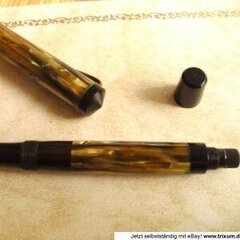
Don't use alcohol in a pen. Some of the Rapidographs are hard rubber, some are plastic. Some like the one shown below are celluloid. Alcohol will dissolve alcohol, and at the least can cloud the surfaces with which it comes in contact.


THE thing to use is Koh-I-Noor RapidoEze pen cleaner. Very effective in cleaning India ink, and safe for the pen.

spacer.png
Visit Main Street Pens
A full service pen shop providing professional, thoughtful vintage pen repair...

Please use email, not a PM for repair and pen purchase inquiries.

Link to comment
Share on other sites

Create an account or sign in to comment

You need to be a member in order to leave a comment

Create an account

Sign up for a new account in our community. It's easy!

Register a new account

Sign in

Already have an account? Sign in here.

Sign In Now


×
×
  • Create New...