Jump to content

Pen Cap Holes?


WOBentley

Recommended Posts

I am noticing, especially on some of my "older" pens (50's vintage so not that old!) that there is a hole in the cap (Esties, Skylines, even a "lowly" (but fairly pretty) Wearever Pacemaker with some flex to the nib!).

What was the intended purpose of that hole, and does it lead to drying of the nib if the pen sits for a few days? If so, can they be safely "plugged" with some sort of clear sealant to prevent this from happening? I have not noticed the drying effect, but I keep only 2 or so pens inked at a time so they get used frequently.

Thanks!

Dave

This post contains 100% recycled electrons

http://i952.photobucket.com/albums/ae8/Catriker/Pen%20Pics/SmallCzarNikolai.jpg

Link to comment
Share on other sites

  • Replies 14
  • Created
  • Last Reply

Top Posters In This Topic

  • Roger W.

    5

  • Denny

    3

  • jar

    1

  • WOBentley

    1

Top Posters In This Topic

Posted Images

They were meant to balance the air pressure inside the cap with the air pressure surrounding the sac. Plugging them is not a good idea.


Link to comment
Share on other sites

When the cap is screwed on, the holes do not expose the nib to air. It won't dry out with the cap in place. It's only when you unscrew the cap slightly that the air gets to the nib and equalizes the pressure.

Edited by ANM

And the end of all our exploring

Will be to arrive where we started

And know the place for the first time. TS Eliot

Link to comment
Share on other sites

On my Noodler's piston fill pens the hole in the cap definitely exposed the nib to outside air, and once I plugged the hole it stopped drying out. If I remember correctly the hole was to prevent the cap from forming a vacuum and sucking ink out when you take it off, I've only had minor issues in this regard. Is it much worse with older pens?

Link to comment
Share on other sites

On my Noodler's piston fill pens the hole in the cap definitely exposed the nib to outside air, and once I plugged the hole it stopped drying out. If I remember correctly the hole was to prevent the cap from forming a vacuum and sucking ink out when you take it off, I've only had minor issues in this regard. Is it much worse with older pens?


I can't imagine any pen being made with a hole where it isn't needed. Newer pens often don't have holes. Vintage pens do need the holes to prevent the vacuum from uncapping as the feeds were inadequate. As the feeds improved Sheaffer went from four holes to two and you see the other makers doing that as well. The nib, when fully closed, is in an airtight chamber formed by the inner cap and the section end.


Roger W.

Link to comment
Share on other sites

There is no hole in my Papermate "toothpick" cap. I do not use the pen because of the thin grip; the pen has been filled for 10 years and it always starts on the first stroke when I test it. So I doubt the breather holes in the cap are necessary (just my opinion).

Edited by Denny
Link to comment
Share on other sites

There is no hole in my Papermate "toothpick" cap. I do not use the pen because of the thin grip; the pen has been filled for 10 years and it always starts on the first stroke when I test it. So I doubt the breather holes in the cap are necessary (just my opinion).


Breather holes are not necessary in your particular cap. They are necessary in other caps. I find it hard to believe Nathan would have a pen manufactured with holes if the holes were not considered necessary unless, perhaps, it was a design oversight. Sheaffer seems to have stopped using holes in the 1940's so it isn't as needed as it was prior to that time but, certain designs may still require such.


Roger W.

Link to comment
Share on other sites

As Jar has correctly stated, the hole is there to balance out air-pressure.


If there was no hole in the cap, then uncapping the pen would cause a vacuum, which would likely suck ink out of the pen and create a big, inky mess everywhere. So don't plug it, whatever you do!


Some pens have this arrangement, some don't. I've seen modern pens with cap-holes, I've seen vintage pens without them, it all depends. But if you're wondering what the hole is there for; that's why. Most vintage pens (vintage ca. 1950 & before) will have one or two holes drilled into the cap for pressure-balancing purposes. Modern pens (if they have a hole at all) will usually just have one, and one hidden in a discreet location (such as under the clip) to keep the aesthetics.

Edited by Shangas

http://www.throughouthistory.com/ - My Blog on History & Antiques


Link to comment
Share on other sites

All this talk of vacuums is beginning to me to sound like urban legend. I have also read that the holes were there to prevent choking when the cap was swallowed by an infant. I think that even less likely. If a cap is threaded, it would seem just about impossible to unscrew it and pull it off before air passing through the loosened threads could equalize the pressure, at least enough to keep ink from being drawn out through the feed. I suppose that if a really old pen with a crude feed had a slip cap, and maybe if you coated the barrel with oil to ensure a good seal, it would be possible to rip the cap off fast enough to pull enough of a vacuum to draw a few drops of ink onto the nib. But is that a realistic case?

I think I can get drops of ink from a modern Chinese pen by ripping off the cap, but that is because the caps snap on so firmly that removing them quickly with two hands inevitably flicks the pen like a stubby little bull whip. I've never seen ink drops by quickly unsnapping the cap of said pens using one hand, even though I often seal up the caps to prevent drying.

More to the point, has anyone ever actually seen rapid removal of a cap cause ink to leak from the pen? It doesn't count if your rapid removal jostles the pen enough to shake some ink out. Has anyone ever tried to get drops of ink off the nib in this way, and then sealed the little hole in the cap and any airway around the clip, and then repeated the experiment to see if the hole made any difference?

ron the perennial skeptic

Link to comment
Share on other sites

All this talk of vacuums is beginning to me to sound like urban legend. I have also read that the holes were there to prevent choking when the cap was swallowed by an infant. I think that even less likely. If a cap is threaded, it would seem just about impossible to unscrew it and pull it off before air passing through the loosened threads could equalize the pressure, at least enough to keep ink from being drawn out through the feed. I suppose that if a really old pen with a crude feed had a slip cap, and maybe if you coated the barrel with oil to ensure a good seal, it would be possible to rip the cap off fast enough to pull enough of a vacuum to draw a few drops of ink onto the nib. But is that a realistic case?

I think I can get drops of ink from a modern Chinese pen by ripping off the cap, but that is because the caps snap on so firmly that removing them quickly with two hands inevitably flicks the pen like a stubby little bull whip. I've never seen ink drops by quickly unsnapping the cap of said pens using one hand, even though I often seal up the caps to prevent drying.

More to the point, has anyone ever actually seen rapid removal of a cap cause ink to leak from the pen? It doesn't count if your rapid removal jostles the pen enough to shake some ink out. Has anyone ever tried to get drops of ink off the nib in this way, and then sealed the little hole in the cap and any airway around the clip, and then repeated the experiment to see if the hole made any difference?

ron the perennial skeptic


I'll try again. The manufacturers put the holes in the cap to keep from forming a vacuum. They are exactly inbetween the closure of the inner cap and the section end and the threads. Feeds weren't as good on the oldest of pens so ink was likely to drip. There are early pens without holes but Sheaffer and Boston always have them in the early years for this very reason. I'm not familiar with other makers.


If it helps to bolster my case one can also look at Richard Binder's glossary at richardspens.com under the second definition of breather holes. No one need experiment to see what works or what doesn't as this is why they bothered to put the holes there. Wasting time to do extra steps while making pens was not the practice of vintage pen manufacturers. I know many modern pens like circa 1980 Sheaffer Targas don't have holes but the feeds are pretty well perfected.


Roger W.

Link to comment
Share on other sites

I have one Esterbrook with a hole, and I wish all my pens without holes could sit around and not dry out like my Ester.

1 Homo Sapien BA Maxi & Mech Pencil, HS Misnight in Florence, 2 Van Goghs 1 Blue Ocean Midi S Nib/1 Cappuccino Midi 14k Trim, 3 MBs 149/144/221, 2 Wm Phileas 1 Blue w/ mech pencil, 1 Demo, 1 Snorkel Sent., 3 MVs Regatta/Invincia/Artista,2 EB J - BSP,I am Not Affiliated with any website, company or product I might mention on this site."
Link to comment
Share on other sites

Sheaffer seems to have stopped using holes in the 1940's so it isn't as needed as it was prior to that time but, certain designs may still require such.


Roger W.


Thanks for explanation Roger.

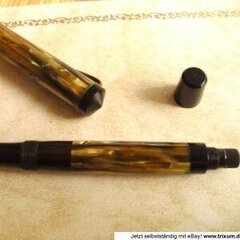
I checked my Sheaffers and there is no breather hole in Sheaffer Prelude and in Triumph either, (I have never noticed before - I have never had a problem related to opening the cap and ink leaking [or burpping]). On the other hand the Sheaffer in the picture attached (I can't identify the model) there is a breather hole and I did have a problem with burpping but the problem went away when I changed the convertor.

If the breather hole is for balancing air pressure inside the cap when removing it, then threaded caps would not need the hole - the only threaded pen I have is Pilot 78G - and it does not have a breather hole ...

I think (and a simple calculation shows) that the drop in air pressure inside the cap is insignificant.

Take a cap in 10 mm dia and 20 mm length (I shortend it because some space inside the cap is taken by the nib and feed and the grip) and while removing the cap you pull it 3 mm before the air gets in.

From p*V = const we get that the drop in air pressure is inversly proportional to increase in volume of air inside the cap. Increase of volume of air during cap removal is 1800/1570 = 1.146 x. This means the air pressure drops 1/1.146 = 0.87 x. I think it is insignificant.


Feeds weren't as good on the oldest of pens so ink was likely to drip.

This is what I think that modern pens with good feed design and manufacture do not need breather hole. (but it's just my opinion).

post-9092-0-70731300-1315962479.jpg

Link to comment
Share on other sites


If the breather hole is for balancing air pressure inside the cap when removing it, then threaded caps would not need the hole - the only threaded pen I have is Pilot 78G - and it does not have a breather hole ...

I think (and a simple calculation shows) that the drop in air pressure inside the cap is insignificant.

Take a cap in 10 mm dia and 20 mm length (I shortend it because some space inside the cap is taken by the nib and feed and the grip) and while removing the cap you pull it 3 mm before the air gets in.

From p*V = const we get that the drop in air pressure is inversly proportional to increase in volume of air inside the cap. Increase of volume of air during cap removal is 1800/1570 = 1.146 x. This means the air pressure drops 1/1.146 = 0.87 x. I think it is insignificant.


On a modern pen threads or pull doesn't make a difference but, on vintage pens the feeds were much more sensitive to pressure raising a drop or having the feed flood. Sheaffers and Bostons are both threaded caps that have breather holes. The feeds were improved in them as they had fins for aiding in the distribution of ink and avoiding flooding. A Boston eyedropper will still drip on occasion and you don't want to start writing with a flooded feed as there is no way to right faster than the controlled leak that a fountain pen is - a drip is likely on the way. Leaking was so persistent in early pens that it was a key advertising point that your pen would not leak. Boston worked hard to that end with finned feeds and caps with breather holes. Every edge had to be used to make your pen as leak proof as possible. Other makers resorted to shut-off valves - it was that real of an issue.


Roger W.

Link to comment
Share on other sites

Leaking was so persistent in early pens that it was a key advertising point that your pen would not leak. Boston worked hard to that end with finned feeds and caps with breather holes. Every edge had to be used to make your pen as leak proof as possible. Other makers resorted to shut-off valves - it was that real of an issue.


Roger W.


Thanks Roger,

do you mean leaking due to cap removal or just leaking when using the pen?

I have been using fountain pens for whole my (rather long) life and I had always inky fingers, but I do not remember a pen leaking when opening it. Early pens that I was using had all threads (as I remember). They were Centropen Czech made pens in 1960-70.

Link to comment
Share on other sites

Leaking was so persistent in early pens that it was a key advertising point that your pen would not leak. Boston worked hard to that end with finned feeds and caps with breather holes. Every edge had to be used to make your pen as leak proof as possible. Other makers resorted to shut-off valves - it was that real of an issue.


Roger W.


Thanks Roger,

do you mean leaking due to cap removal or just leaking when using the pen?

I have been using fountain pens for whole my (rather long) life and I had always inky fingers, but I do not remember a pen leaking when opening it. Early pens that I was using had all threads (as I remember). They were Centropen Czech made pens in 1960-70.


Denny;


Generally, they don't leak when opened so much as flood the feed. With flooded feed on a half full Boston eyedropper the heat off your hand on the barrel is really likely to take it over the top. For the fins to catch the odd extra ink they have to be available to do so. Bostons made nice improvements but my 13 dripped more than once with use - primarily due to heat expansion on the barrel air. Without the breather holes I think it would have happened all the time. One Boston box lid has the logo CANNOTLEAK it was that important a statement to show you were selling a superior pen and Bostons were at the time as Walter Sheaffer stated they were one of his main competitors.


Sheaffer, at that time, went to the extend of drilling the cap twice to produce four breather holes. When you are producing over 200,000+ (way more actually as this is approximately second half of 1912-1913) pens a year every extra step is only taken if it is felt it is necessary. Feed improvements allowed them to drop to one drilling thru the cap for two breather holes in the later teens.


Roger W.

Link to comment
Share on other sites

Create an account or sign in to comment

You need to be a member in order to leave a comment

Create an account

Sign up for a new account in our community. It's easy!

Register a new account

Sign in

Already have an account? Sign in here.

Sign In Now


×
×
  • Create New...