Jump to content

How do you measure line width?


Arts11

Recommended Posts

This has been something I've kinda been wondering for awhile now, but how do you measure line width?


I've seen plenty of charts showing the line widths of various nib sizes, but how are they measured exactly? I can't imagine nibmeisters/penmakers using a regular wooden ruler to do it, but is there some other consumer tool that can measure the line width that precisely? The main reason why I'm wondering now is b/c I'm starting to send pens out to nibmeisters and I'd like to be able to tell them approximately what sized line widths I prefer [paper/ink is obviously a factor, but still].

Link to comment
Share on other sites

  • Replies 23
  • Created
  • Last Reply

Top Posters In This Topic

  • OiRogers

    4

  • hari317

    3

  • Arts11

    3

  • ImolaS3

    2

Top Posters In This Topic

This has been something I've kinda been wondering for awhile now, but how do you measure line width?


I've seen plenty of charts showing the line widths of various nib sizes, but how are they measured exactly? I can't imagine nibmeisters/penmakers using a regular wooden ruler to do it, but is there some other consumer tool that can measure the line width that precisely? The main reason why I'm wondering now is b/c I'm starting to send pens out to nibmeisters and I'd like to be able to tell them approximately what sized line widths I prefer [paper/ink is obviously a factor, but still].

Your question prompted me to get out a metal ruler and a 5x magnifier. My Lamy Safari's 1.1 mm italic nib produces a line width of about .7 to .8 mm with Noodler's Baystate Blue ink. The nib itself appears to be 1.0 mm wide.


With a little practice and a magnifier, you should be able to divide 1 mm scale divisions into .1 mm increments (inkrements!) with reasonable consistency.


You'll want to be sure that you and your chosen nibmeister are describing the line width the same way.

Link to comment
Share on other sites

I have a cheap chinese loupe which has a scale measured in 1/10 of a mm. This is perfect for measuring the line width of your pen.

Link to comment
Share on other sites

Hi,

I get some good paper like Rhodia, and some i-g ink then draw some straight lines (down-stroke) with the nib.

I scan the line, and using Ouija board math, figure out the width of the line. You need to nkow your scan resolution and what your monitor's resolution. I usually include a line of known width to ensure I'm not making significant error/s.

I used to include such stuff in my Ink Reviews until bandwidth concerns encouraged me to delete them, but I think I can sneak-in a sample here, (no one reads my posts anyway):

http://i783.photobucket.com/albums/yy116/Sandy1-1/PQR2_Share/FPN153.jpg


http://i783.photobucket.com/albums/yy116/Sandy1-1/PQR2_Share/FPN152.jpg

The only time you have too much fuel is when you're on fire.


Link to comment
Share on other sites

I use a digital caliper and a magnifying glass to measure my line widths. Works for me, at least to an accuracy of about +/- 0.05 mm. It's good for me to know what size nib makes what line width. I can then judge when I get a new pen, and want to grind it to an italic, what kind of italic line variation I can expect when finished.


Kirk

Link to comment
Share on other sites

I also use a scanner, set to the maximum possible resolution. Then I import the scan into my photo editing program, in my case Photoshop Elements. But any program that lets you (1) use a drawing tool that you can size in pixels and (2) adjust the viewing resolution in pixels per inch will work. You simply set the screen resolution to match the original scan resolution and then size the tool until it matches the width of your scanned line, now you know how many pixels wide the line is. Since you know the scan resolution you can calculate very accurately the line width. I'm not sure that the step of matching the screen resolution to the original scan resolution is necessary, but that's the way I've always done it.

Edited by sexauerw

Bill Sexauer
http://bulk-share.slickpic.com/album/share/zyNIMDOgTcgMOO/5768697.0/org/p/PCA+++Logo+small.jpghttp://bulk-share.slickpic.com/album/share/zyNIMDOgTcgMOO/5768694.0/org/p/Blk+Pen+Society+Icon.jpghttp://bulk-share.slickpic.com/album/share/TE3TzMUAMMYyNM/8484890.0/300/p/CP04_Black_Legend%2C_Small.jpg
PCA Member since 2006

Link to comment
Share on other sites

Interesting responses. I've actually tried the ruler method, but I can only really measure about .5mm with certainty. I can guestimate rought fractions like 1/3 and maybe 1/4 mm's, but like some of the nibmeisters have more exact measurements like 0.x2 or 0.x6.

Link to comment
Share on other sites

I use a magnifier with an interchangeable reticule. Bought it from Edmund Scientific many years ago, was not too expensive. Mine is for measuring soil sediment sizes and has a highly magnified scale with divisions of 0.2 mm. This useful tool has many uses.


Bob

Pelikan 100; Parker Duofold; Sheaffer Balance; Eversharp Skyline; Aurora 88 Piston; Aurora 88 hooded; Kaweco Sport; Sailor Pro Gear


Eca de Queroiz: "Politicians and diapers should be changed frequently, and for the same reason."

Link to comment
Share on other sites

I use a Graticule magnifier. This is a surface contact type magnifier with interchangeable graticules. You can find these easily with Dealers who supply PCB inspection equipment.


Link to an example:


http://in.rsdelivers.com/product/rs/graticule-magnifier-10x/2009425.aspx

Edited by hari317

In case you wish to write to me, pls use ONLY email by clicking here. I do not check PMs. Thank you.

Link to comment
Share on other sites

This has been something I've kinda been wondering for awhile now, but how do you measure line width?


I've seen plenty of charts showing the line widths of various nib sizes, but how are they measured exactly? I can't imagine nibmeisters/penmakers using a regular wooden ruler to do it, but is there some other consumer tool that can measure the line width that precisely? The main reason why I'm wondering now is b/c I'm starting to send pens out to nibmeisters and I'd like to be able to tell them approximately what sized line widths I prefer [paper/ink is obviously a factor, but still].


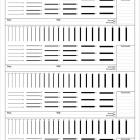
You could print the attached pdf-file (on a relatively high resolution printer (600 dpi perharps?)), draw some lines with a nib of your choice, and then compare them to the sample lines on the print. When printing, make sure you choose "page scaling: none" in Acrobat reader.

linewd_template.pdf

tane

Link to comment
Share on other sites

The things you learn....but if you send a pen to a nibmeister and tell him you want an Xf, or XXF or XXXF, and ask him what width does he grind it....wouldn't that make measuring so scientifically unneeded?


Well thanks a lot....now I need tools to measure those nib's I'm not sure of.


It's my observation, and as blind as I've been lately, probably wrong, this "exactness" of width has to do with EF, EEF, and EEEF.

I've not noticed any one saying they wanted a M exactly xxx wide.


I am sort of "noobie" with Fine and especially with Extra Fine, and have no intention of going to EEF, or EEEF. Thats why you have Rotring...IMO, as ignorant as it is.


Maybe I'm just ham fisted, but I find an EF/EEF in a huge pen to be sort of odd. If the EF/EEF then why not a pen that is more maneuverable.


You forced me to go to a primitive method just to see what I had, in F or better.

A sheet of paper, the name of the pen and a line that went out and then down the paper.


I have only two extra fines, a MB 320 and a Reform 125, both came in this week. Neither is semi-flex. Those are my very first EF's.

I have a Mercedes semi-flex OF that can draw a XF line, but with a little bit of writing pressure writes wider, it can write wider than F, easy.

I have a broken piston DDR pen that is a fine.

I have a Pelikan Fine that is a joy to write with. There is absolutely no way I'm going to fiddle with a IMO in normal flex, a perfect nib.

A nice Reform 120 and a Reform 1745 that are fines.

I have a Pelikan semi-flex OF, that can be taken thicker with a bit of pressure. I like that nib exactly the way it is.


Do you grind your semi-flex or Flex pens also?

The Reality Show is a riveting result of 23% being illiterate, and 60% reading at a 6th grade or lower level.

      Banker's bonuses caused all the inch problems, Metric cures.

Once a bartender, always a bartender.

The cheapest lessons are from those who learned expensive lessons. Ignorance is best for learning expensive lessons.


Link to comment
Share on other sites

Like Kirk mentioned... I make use of a set of digital calipers. I have a few sets from reloading handgun and rifle rounds.

Mine are accurate to 0.0001mm. Much, much finer resolution than I require for a nib. Also, much finer than I am able to eyeball when I lay the calipers on the page.

Link to comment
Share on other sites

Mine are accurate to 0.0001mm.


Wow! That is a fine set of calipers that you have, which is the make?

In case you wish to write to me, pls use ONLY email by clicking here. I do not check PMs. Thank you.

Link to comment
Share on other sites

For caliper-less people, on Richard Binder's website is a very good stroke-width chart:


Richard's Pens


Go to the Repair and Restoration page and scroll south for the download.

Link to comment
Share on other sites

To measure line width, I use a verier caliper (digital display) with a magnifier. but then as an engineer, I have these lying around

Please visit my new pen and ink/pen box site at www.boxesandpens.co.uk

Hand made boxes to store and display your favourite pens.

10% discount for FPN members

Link to comment
Share on other sites

Mine are accurate to 0.0001mm.


Wow! That is a fine set of calipers that you have, which is the make?

I'd like to know this too. Don't know how much digital calipers cost, but if they're generally inexpensive, then I might just go buy one.

Link to comment
Share on other sites


Mine are accurate to 0.0001mm.


???? Are you sure?? That is 100nm (nano metres!!)


I am an expert in instrumentation and measurement and our £160,000 CMM machine that had to be calibrated in situ for 2 weeks and is kept at a steady 20 degrees C (plus or minus 0.5 degrees C) only measures to 10nm.


Most vernier calipers, including expensive Mitutoyo ones, have a resolution of 0.01mm (0.5 thou) and an accuracy of 0.02 or 0.04mm (accuracy and resolution are not the same thing)

Please visit my new pen and ink/pen box site at www.boxesandpens.co.uk

Hand made boxes to store and display your favourite pens.

10% discount for FPN members

Link to comment
Share on other sites


Mine are accurate to 0.0001mm.


???? Are you sure?? That is 100nm (nano metres!!)


I am an expert in instrumentation and measurement and our £160,000 CMM machine that had to be calibrated in situ for 2 weeks and is kept at a steady 20 degrees C (plus or minus 0.5 degrees C) only measures to 10nm.


Most vernier calipers, including expensive Mitutoyo ones, have a resolution of 0.01mm (0.5 thou) and an accuracy of 0.02 or 0.04mm (accuracy and resolution are not the same thing)


That is why I was interested to know the make, I think it was a typo.

In case you wish to write to me, pls use ONLY email by clicking here. I do not check PMs. Thank you.

Link to comment
Share on other sites

Would appear I put an extra zero in there, I appologise. Both sets I use came from Sinclair International and are intended for use in benchrest and match grade rifle reloading. Cheap / inexpensive they were not. They weren't even "reasonable" in price.

I could have easily purchased a .50bmg rifle or two for the investment in the calipers.


Edit to add: Would appear I put a spare "0" in there... my appologies. Just consulted some .50bmg load data from my last batch. I measure to 3 places (0.xxx) and pretty much disregard the 3rd place as extranious for all but my match rounds. From a quick google, would appear 0.001 resolution with 0.004 accuracy.

Edited by OiRogers
Link to comment
Share on other sites

A brief reply... I dug out paperwork on a couple of my instruments.


Mitutoyo Digital Electronic Caliper... claimed accuracy 0.0015" or 0.025mm. So I'm an idiot... forgot to convert inches to mm.:blink:

Mitutoyo Digital Micrometer.... Claimed accuracy 0.00005" (inches)... a bit too tired to do the conversion to mm

Starrett Digital Micrometer.... Claimed accuracy 0.0001" or 0.003mm again... I'm an idiot and forgot to convert inches to mm...


Vast scale of difference Inches to MM.... I need to drink more coffee before I post. :blink::mellow:


Those are my "knock around" sets that I use on the bench for rough work... I can't seem to locate the paperwork on my better sets of calipers... also Mitutoyo made that I know had much finer claimed accuracy.... I know they work well as my match grade .50bmg rounds tightened up the groupings at 1000yards pretty significantly. It's pretty incredible how much of a difference a fraction of a mm of case length will result in a measurable change in grouping 1000yards down range. Either way... these tools are more than capable of measuring a 1/10th of a mm in line width if my eyes can do their part.


I do apologize to all for my error in scale of Standard to Metric... my only excuse is general stupidity. :blush:

Link to comment
Share on other sites

Create an account or sign in to comment

You need to be a member in order to leave a comment

Create an account

Sign up for a new account in our community. It's easy!

Register a new account

Sign in

Already have an account? Sign in here.

Sign In Now


×
×
  • Create New...