Jump to content

Waterman 52, F?


Tsujigiri

Recommended Posts

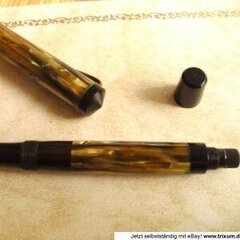
Up until this pen, I had only new pens. This is my first vintage pen, the iconic 52. It is one of the more available vintage pens, especially at this age. This particular pen was made between 1928 and 1931, judging from the clip, imprints, and size.


http://i275.photobucket.com/albums/jj309/tsujigiri01/_MG_1511.jpg


Build Quality: 8/10


The pen is well-build and seems solid. The filler rattles a little and the threads aren’t as smooth as usual, probably due to the hard rubber material the pen is made of. It seems reliable, but not perfectly fitted like a Sailor 1911.


http://i275.photobucket.com/albums/jj309/tsujigiri01/_MG_1517.jpg


Grip, Balance, and Feel: 8/10


The hard rubber is really nice for a grip. The material is slightly less slippery than modern plastic. The pen is very small, however, which is less comfortable than a wider grip. I was very surprised at its small size; this pen would not be considered normal-sized by modern standards. The nib is even a bit smaller than the Pelikan m200’s. Balance is not a problem with this pen; it is exceptionally light. I can’t recall another pen that has seemed so lightweight. The cap does not fit well on the back of the pen, so I assume it is not meant to be posted.


http://i275.photobucket.com/albums/jj309/tsujigiri01/_MG_1516.jpg


Filling System: 7/10


The 52 has a lever-filling system typical to early pens. It is easy to replace (which I did, my first foray into pen repair), holds a good deal of ink, and is convenient to use. It does not, however, allow the user to see how much ink is left in the pen. For this pen, the inside of the barrel is quite long in dimension, so I barely had to cut down the ink sac. The result is a very nice ink capacity compared to some other lever-filled pens. The lever is housed in a metal box, which Waterman did to get around the original Sheaffer patent for a lever-filling pen. I like the look and sturdiness of this design a little better, personally. The lever clicks back into place when it is restored to the retracted position.


http://i275.photobucket.com/albums/jj309/tsujigiri01/_MG_1518.jpg


Nib: 8/10


My nib came bent, so I returned the tines to a side-by-side position with my fingernail. There is a slight kink in the nib from the bending, but the tines are aligned and the pen seems to write well. The nib is a little scratchy, but functions beautifully, and lays down a wet line with plenty of ink. The feed, although simple, seems to have no trouble keeping up with ink flow. These nibs come in various degrees of flex, and I’m not sure what mine would be classified as. It seems fairly flexy. The nib is fine enough (not sure of the exact size, but I’d guess fine) that I can get a fair amount of line variation, more than I can get with any of my other pens.


http://i275.photobucket.com/albums/jj309/tsujigiri01/_MG_1513.jpg


Value: 9/10


I bid on a couple Ebay auctions before winning this one. The first one was a restored pen open to worldwide buyers that closed at about $110. This one was labeled as “outstanding vintage Watermans pen,” and closed at $86 with shipping, under my winning bid. It was unrestored, so I ordered a sac separately for a small cost. I’m guessing that most people who were searching for a Waterman 52 didn’t see this one because the pen model was not listed in the title. That being said, the pen is a great specimen. It’s from later in the 52’s production run, so it’s not as valuable, but I wanted a user more than a collectable. This pen is remarkably clean, with just a little oxidation and very minor corrosion on the clip. I’m guessing that someone kept it in a drawer for most of the time since it was made. It also has a heart-shaped breather hole in the nib, which the other didn’t have. This doesn’t affect the value, but I thought it was cool. Given the condition, I think this was a fairly good deal for this particular pen, and a very good deal for a pen in general. A modern pen with a 14k nib and integrated filling mechanism would cost at least $150. These go for well under that and offer a history that modern pens don’t. It amazes me that 80 year-old pens like this can be so readily available. This model is a particularly good value for old pens, it seems. There aren’t any other pens around the 52’s age that are so easily available at reasonable prices.


http://i275.photobucket.com/albums/jj309/tsujigiri01/_MG_1514.jpg


Conclusion:


This pen has opened my eyes to the value and intrigue vintage pens offer. The Waterman 52 is an excellent pen as a representative of the BCHR pens that dominated the market from the 1910’s to the 1920’s. It offers merits in its own right as a pen, but also in its history and significance in the pen world. I am very glad to have this as an addition to my collection. This pen is just more “fun” to use than a lot of modern pens, and it is this that seems to be the distinguishing quality of vintage writing implements.


Link to comment
Share on other sites

  • Replies 8
  • Created
  • Last Reply

Top Posters In This Topic

  • tipstricks

    2

  • Tsujigiri

    2

  • Breck

    1

  • RevAaron

    1

Top Posters In This Topic

Good find, good photos, and very nice review! I'm happy to see the recent spate of vintage pen reviews going up.


Congrats on a lovely pen, and especially on completing your first project pen.


Link to comment
Share on other sites

For a first vintage pen the 52 is a very good first choice. I'd personally rather start there than with a 52 if only because it gives you much more of the vintage flavor that many of us love.


You've a great looking pen, far above what I'd put in a "user 52" category. That's a great thing about the 52- you can find some really discolored specimens that write incredibly for dirt cheap. For the 52s I'll use as carry with me pens I wouldn't care if they got discolored or worn, simply because they're already so worn and brownish. :P Be careful with this little guy.


One of the most impressive features of Waterman's from this area is that they're remarkably smooth, more than most of their contemporaries. Especially given modern sensibilities for how a nib is expected to feel- they've less feed back than the Sheaffer and Parker pens from the same time. Don't get me wrong, I like feedback- but it often amazes me how modern many of the 5x nibs I've used feel.


Enjoy!

WTB: Lamy 27 w/ OB/OBB nibs; Pelikan 100 B nib

Link to comment
Share on other sites

Many thanks for this great review! The bchr 52 is been my first vintage flex nib fountain pen, and it's one of my preferred.

If you agree I can add a writing sample, written with Parker Quink black ink:


http://lh4.ggpht.com/_1v8Xv71Du3g/SIoEEHAp_jI/AAAAAAAAC7w/E-bUOG5qqsw/s800/P1020003.jpg

Edited by tipstricks
http://i252.photobucket.com/albums/hh20/tipstricks_photo/31032009052_cr.jpg - My albums
Link to comment
Share on other sites

Tsujigiri, you choose a wonderful way to test the Vintage side of pens! Beautiful specimen at a great price. Next should be a Sheaffer's Flat Top.

Tipstricks, your penmanship is simply beautiful. Can you write like this at speed?


Ciao,

<font face="Verdana"><b><font color="#2f4f4f">d</font></b><font color="#4b0082">iplo</font></font><br /><br /><a href='http://www.fountainpennetwork.com/forum/index.php?showuser=6228' class='bbc_url' title=''><font face="Trebuchet MS"><br /><font size="4"><b><font color="#8b0000"><font color="#696969">Go</font> <font color="#006400">To</font> <font color="#a0522d">My</font> <font color="#4b0082">FPN</font> Profile!</font></b></font></font><br /></a>

Link to comment
Share on other sites

Tipstricks, your penmanship is simply beautiful. Can you write like this at speed?


Ciao,


I try to explain in this way:

In the XXI century we have cars can go over 200km/h, but in the '20 there were cars didn't go over 50km/h. So, velocity is relative: with a 80 years old fountain pen I can't go at actual speed :D


Ciao

http://i252.photobucket.com/albums/hh20/tipstricks_photo/31032009052_cr.jpg - My albums
Link to comment
Share on other sites

Thank you for the comments! That's some beautiful writing, tipstricks. I tried to copy that down with my 52, but fell short of the mark to say the least. Maybe with some more practice...

Link to comment
Share on other sites

  • 2 months later...
Up until this pen, I had only new pens. This is my first vintage pen, the iconic 52. It is one of the more available vintage pens, especially at this age. This particular pen was made between 1928 and 1931, judging from the clip, imprints, and size.


http://i275.photobucket.com/albums/jj309/tsujigiri01/_MG_1511.jpg


Build Quality: 8/10


The pen is well-build and seems solid. The filler rattles a little and the threads aren’t as smooth as usual, probably due to the hard rubber material the pen is made of. It seems reliable, but not perfectly fitted like a Sailor 1911.


http://i275.photobucket.com/albums/jj309/tsujigiri01/_MG_1517.jpg


Grip, Balance, and Feel: 8/10


The hard rubber is really nice for a grip. The material is slightly less slippery than modern plastic. The pen is very small, however, which is less comfortable than a wider grip. I was very surprised at its small size; this pen would not be considered normal-sized by modern standards. The nib is even a bit smaller than the Pelikan m200’s. Balance is not a problem with this pen; it is exceptionally light. I can’t recall another pen that has seemed so lightweight. The cap does not fit well on the back of the pen, so I assume it is not meant to be posted.


http://i275.photobucket.com/albums/jj309/tsujigiri01/_MG_1516.jpg


Filling System: 7/10


The 52 has a lever-filling system typical to early pens. It is easy to replace (which I did, my first foray into pen repair), holds a good deal of ink, and is convenient to use. It does not, however, allow the user to see how much ink is left in the pen. For this pen, the inside of the barrel is quite long in dimension, so I barely had to cut down the ink sac. The result is a very nice ink capacity compared to some other lever-filled pens. The lever is housed in a metal box, which Waterman did to get around the original Sheaffer patent for a lever-filling pen. I like the look and sturdiness of this design a little better, personally. The lever clicks back into place when it is restored to the retracted position.


http://i275.photobucket.com/albums/jj309/tsujigiri01/_MG_1518.jpg


Nib: 8/10


My nib came bent, so I returned the tines to a side-by-side position with my fingernail. There is a slight kink in the nib from the bending, but the tines are aligned and the pen seems to write well. The nib is a little scratchy, but functions beautifully, and lays down a wet line with plenty of ink. The feed, although simple, seems to have no trouble keeping up with ink flow. These nibs come in various degrees of flex, and I’m not sure what mine would be classified as. It seems fairly flexy. The nib is fine enough (not sure of the exact size, but I’d guess fine) that I can get a fair amount of line variation, more than I can get with any of my other pens.


http://i275.photobucket.com/albums/jj309/tsujigiri01/_MG_1513.jpg


Value: 9/10


I bid on a couple Ebay auctions before winning this one. The first one was a restored pen open to worldwide buyers that closed at about $110. This one was labeled as “outstanding vintage Watermans pen,” and closed at $86 with shipping, under my winning bid. It was unrestored, so I ordered a sac separately for a small cost. I’m guessing that most people who were searching for a Waterman 52 didn’t see this one because the pen model was not listed in the title. That being said, the pen is a great specimen. It’s from later in the 52’s production run, so it’s not as valuable, but I wanted a user more than a collectable. This pen is remarkably clean, with just a little oxidation and very minor corrosion on the clip. I’m guessing that someone kept it in a drawer for most of the time since it was made. It also has a heart-shaped breather hole in the nib, which the other didn’t have. This doesn’t affect the value, but I thought it was cool. Given the condition, I think this was a fairly good deal for this particular pen, and a very good deal for a pen in general. A modern pen with a 14k nib and integrated filling mechanism would cost at least $150. These go for well under that and offer a history that modern pens don’t. It amazes me that 80 year-old pens like this can be so readily available. This model is a particularly good value for old pens, it seems. There aren’t any other pens around the 52’s age that are so easily available at reasonable prices.


http://i275.photobucket.com/albums/jj309/tsujigiri01/_MG_1514.jpg


Conclusion:


This pen has opened my eyes to the value and intrigue vintage pens offer. The Waterman 52 is an excellent pen as a representative of the BCHR pens that dominated the market from the 1910’s to the 1920’s. It offers merits in its own right as a pen, but also in its history and significance in the pen world. I am very glad to have this as an addition to my collection. This pen is just more “fun” to use than a lot of modern pens, and it is this that seems to be the distinguishing quality of vintage writing implements.

Just bought the same pen; it wads made in 1925.

"If the pen is mightier than the sword I am indeed well armed!"

D.P. Mahon

Link to comment
Share on other sites

Create an account or sign in to comment

You need to be a member in order to leave a comment

Create an account

Sign up for a new account in our community. It's easy!

Register a new account

Sign in

Already have an account? Sign in here.

Sign In Now


×
×
  • Create New...